DJI Agras T55, T100 Cleared FCC Days Before US Ban
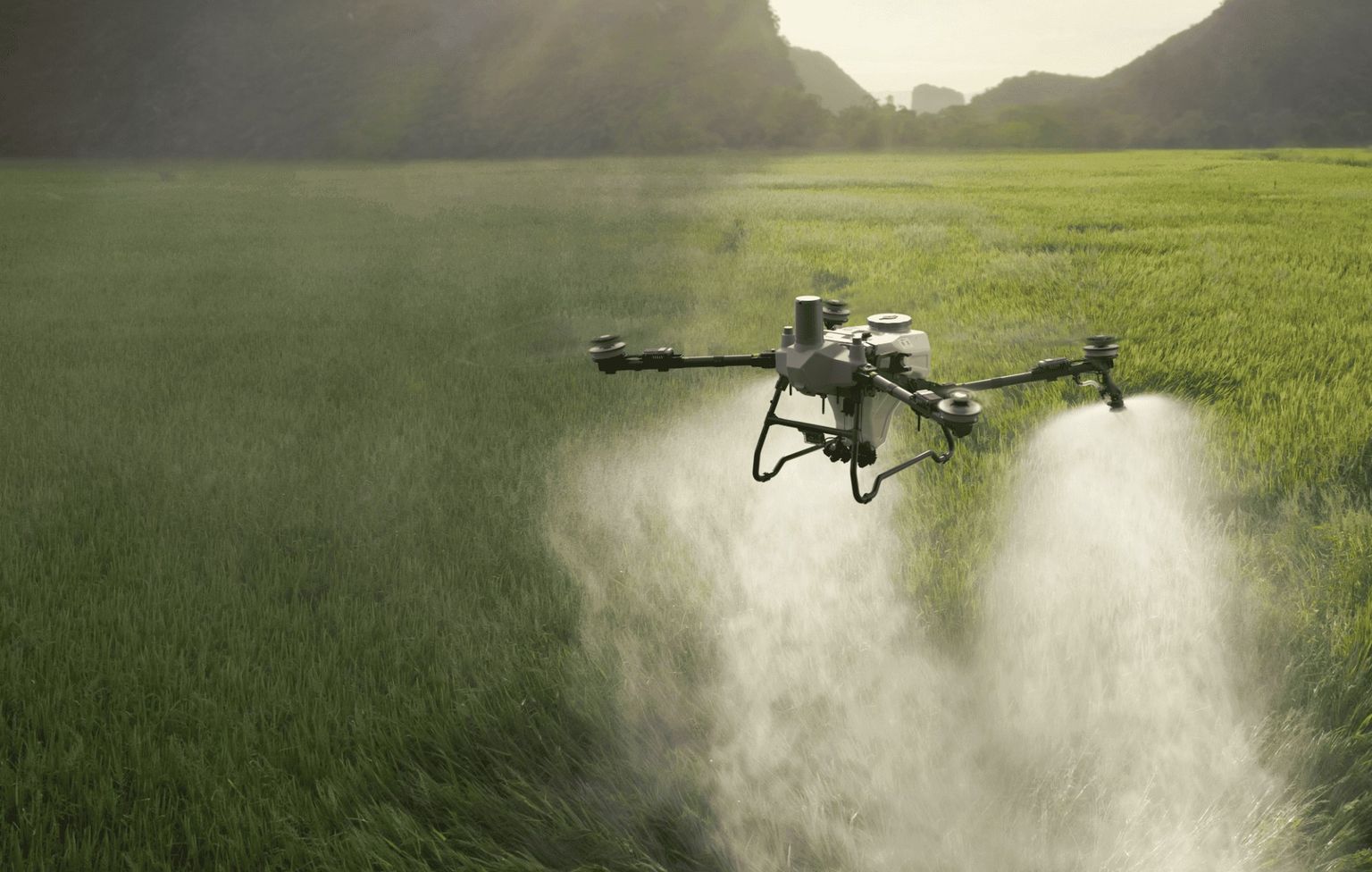
DJI Agriculture launched two new spray platforms worldwide on July 1, 2026: the Agras T55, a 50-liter drone built around an upgraded obstacle-detection radar, and the Agras T100 Dual Battery Spraying System, an endurance upgrade to the flagship DJI shipped last November. Both units cleared FCC equipment authorization in December 2025, just days before the agency added foreign-made drones to its import Covered List — leaving US farmers unable to buy hardware that is technically legal to fly.
Neither model has a confirmed US ship date or price. DJI controls roughly 80% of the US agricultural spray-drone market, according to a Michigan State University study, so the gap directly affects the growers who already rely on the platform.
Background
DJI's agricultural drones spray fertilizer and pesticide over row crops, orchards, and rice paddies, replacing manual backpack sprayers and crewed cropdusters on many farms. The Agras line has been DJI's fastest-growing enterprise product category, with the installed fleet passing 600,000 units globally by April 2026, according to DroneXL. US farms that already run the mid-tier DJI Agras T40 keep flying those units unaffected, but expanding or replacing that fleet with newer hardware is exactly what the import ban blocks.
That growth is now colliding with US trade policy. The FCC's Covered List, expanded under the Secure Equipment Act, blocks the agency from approving new equipment authorizations for companies it designates a national security risk. DJI has disputed its inclusion in federal court, telling the Ninth Circuit in April that 25 unreleased products worth a combined $1.56 billion were stuck in "regulatory limbo" while the case proceeds, per DroneXL. The Agras T55 and T100 are the first major post-ban products to test how that limbo actually plays out for buyers.
What's New in the Agras T55 and T100 Dual Battery
The T55 is the lighter of the two platforms, built for orchards and small-to-mid-size fields. It carries 50 liters of liquid at a 50 L/min flow rate in spray mode, or 55 kg of granular material at 400 kg/min in spreading mode. A new millimeter-wave radar scans at up to 250,000 points per second, and DJI says the upgraded hardware holds up in rain and fog — conditions that previously grounded spray operations.
The T100 Dual Battery Spraying System is an endurance revision of the T100 platform DJI released in late 2025. Running two batteries instead of one increases hover time by 50% at the same payload, letting operators cover more acreage per battery swap. In dual-battery configuration it carries a 90-liter tank through four mist sprinklers at 40 L/min; switched to a single battery, it reverts to the T100's original 150-liter spreading capacity at 400 kg/min.
| Model | Spray/liquid capacity | Spreading capacity | Key upgrade |
|---|---|---|---|
| Agras T55 | 50 L (50 L/min) | 55 kg (400 kg/min) | Millimeter-wave radar, 250,000 points/sec |
| Agras T100 Dual Battery | 90 L (40 L/min) | 150 L / 400 kg/min (single-battery mode) | +50% hover time |
"DJI Agriculture continues to push the boundaries of precision farming, empowering farmers with technology that increases both safety and productivity," said Yuan Zhang, DJI Agriculture's head of global sales, in the company's launch announcement. Both drones are part of the broader Agras lineup covered in our DJI drones guide, which spans the company's consumer, enterprise, and agricultural product lines.
Why the FCC Timing Matters for US Buyers
The T55 cleared FCC equipment authorization on December 19, 2025 (FCC ID SS3-T55A2510); the T100's underlying authorization (FCC ID SS3-T100A2411) predates that. Three days after the T55's approval, on December 22, 2025, the FCC added foreign-made drones to its Covered List, according to DroneXL's reporting on the launch. Because both authorizations were granted before the restriction took effect, they remain valid — a narrow legal window that predates the ban rather than an exemption from it.
That distinction matters in practice. At least one US-authorized dealer, Talos Drones, already lists the base T100 as legal to sell, fly, and support domestically, since its FCC grant is unaffected by the later Covered List action. But an FCC authorization is not the same as a shipped, priced, dealer-supported product: DJI has not committed to a US launch date for either the T55 or the T100 Dual Battery system, and DroneDJ reports availability will vary by country and region as the global rollout proceeds.
Brazil is the clearest example of that uneven rollout. DJI Agriculture confirmed on August 3 that the T55 is now on sale nationwide through its authorized dealer network — over 400 sales and service centers across 27 states, built up since the company entered the country in 2019 — with agricultural drone sales there growing 30-fold between 2021 and 2025, according to the official launch announcement. No comparable dealer network or sales timeline exists yet for the US.
What This Means for Drone Pilots
For growers outside the US, the rollout is straightforward: contact an authorized DJI Agriculture dealer for local pricing and availability, since sales timing varies by market. For US operators, the calculus is more complicated. Existing T100 owners are unaffected, and the FCC authorizations mean a legal path to import the new hardware technically exists. But without a DJI-confirmed US release, growers who need the T55's radar upgrade or the Dual Battery system's extra hover time have no official channel to order one yet.
The wider stakes go beyond these two drones. With DJI holding roughly 80% of the US spray-drone market and 25 more products reportedly awaiting resolution in the Ninth Circuit case, every new global Agras launch will keep testing the same gap between what the FCC has authorized and what DJI is willing to ship stateside. Operators evaluating alternatives should also look at how agricultural platforms compare to other types of drones built for different missions, since spray drones, mapping drones, and inspection drones now diverge sharply in regulatory exposure.
FAQ
Sources: DJI Agriculture — Official Launch Announcement | DroneXL — Agras T55/T100 FCC Timing | DroneDJ — Next-Gen Agras Launch
More like this
Related Articles
FAA Awards $12M for BVLOS Drone Test Research (2026)
The FAA gave $12 million to 19 BVLOS drone research projects on October 5, 2026, as its Part 108 rule sits stalled in White House…
Germany Backs Ukraine With $9.6B Drone Interceptor Deal
Germany and Ukraine signed 15 defense deals worth over $9.6B on Oct. 4, funding mass production of jet-powered interceptor drones…

Wing, Walmart Drone Delivery Hits Denver, Seattle in 2027
Wing and Walmart will launch drone delivery in Denver and Seattle in 2027, expanding toward 270 Walmart stores and 40 million US c…