Anduril Drone Fires First-Ever Missile in USAF Test
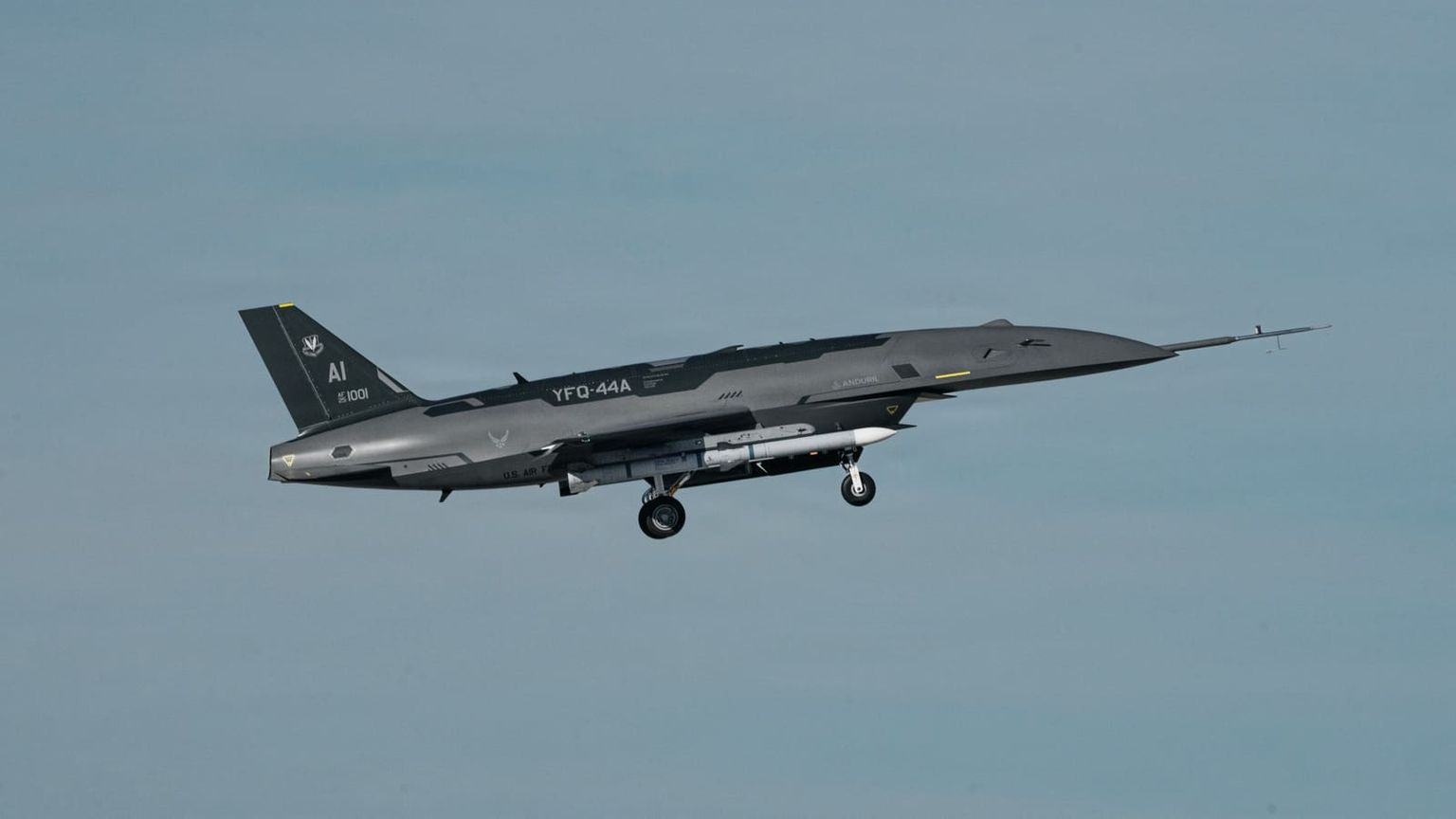
Anduril's YFQ-44A Collaborative Combat Aircraft fired a live AIM-120 AMRAAM air-to-air missile at a simulated target over California's Mojave Desert on July 10, 2026. The US Air Force and Anduril jointly announced the milestone on July 15 — the first time an American autonomous combat drone has launched a guided missile, marking a turning point for uncrewed "loyal wingman" aircraft moving from prototype to weapons-capable hardware.
Background
The Collaborative Combat Aircraft (CCA) program is the US Air Force's effort to field autonomous, jet-powered drones that fly alongside crewed fighters, extending sensor coverage and weapons capacity without adding pilots to the cockpit count. Officials often call this concept a "loyal wingman" aircraft: an uncrewed jet that flies in formation with a crewed fighter, carries its own sensors and weapons, and takes direction from a human pilot or ground operator rather than flying independently. Anduril's YFQ-44A, nicknamed "Fury," and General Atomics' YFQ-42A are the two Increment 1 designs; both companies received production contracts from the Air Force in June 2026.
The service is targeting a fleet of roughly 1,000 CCA aircraft by the end of the decade — a number larger than the total combat aircraft inventory of most individual NATO air forces. Until this test, both designs had flown and demonstrated autonomous maneuvering, but neither had fired a weapon.
| Aircraft | Manufacturer | Nickname | Contract awarded | Live-fire missile test |
|---|---|---|---|---|
| YFQ-44A | Anduril | Fury | June 2026 | July 10, 2026 (confirmed) |
| YFQ-42A | General Atomics | — | June 2026 | Not yet disclosed |
How the Live-Fire Test Worked
The YFQ-44A took off from Edwards Air Force Base and flew the test under the 412th Test Wing's Air Dominance Combined Test Force. According to DefenseScoop, Anduril's Lattice autonomy software — the same system that runs the company's Fury airframe — detected, tracked, and locked onto the simulated target on its own. A human ground operator then issued the final command to fire, and the aircraft executed the launch sequence itself.
A single AIM-120 AMRAAM (Advanced Medium-Range Air-to-Air Missile) launched from an underwing pylon on the jet's port side. Anduril describes the engagement as an "end-to-end, beyond-line-of-sight strike against a simulated target," according to The War Zone — meaning the drone found and engaged a target it could not see with an onboard pilot, relying entirely on sensor and software fusion until the moment of human authorization.
The full kill chain — detect, track, decide to engage, and fire — ran through autonomous software with a human retaining only the trigger-pull, a structure the Air Force calls "human-on-the-loop" rather than a human flying the intercept manually.
Why This Test Matters
Flight testing and simulated maneuvers only prove an aircraft can fly its mission profile. A live-fire shot proves the far harder problem: that an autonomous system can carry, aim, and safely release a live weapon under real flight conditions without a pilot in the cockpit making the call in real time.
According to Air & Space Forces Magazine, the YFQ-44A is now the first American CCA-class design to have successfully launched a guided missile, putting Anduril ahead of General Atomics' YFQ-42A on this specific milestone — though both remain in the same production-contract cohort. The Air Force has not disclosed a timeline for the YFQ-42A's own weapons test.
The economics behind the milestone are as significant as the engineering. Air Force officials say the program is beating its own cost target of roughly $30 million per Increment 1 aircraft — about one-third the price of a crewed F-35 — which is the entire premise behind fielding hundreds of them as expendable, missile-carrying "loyal wingmen" instead of a smaller number of exquisite crewed jets. The June 2026 production contracts covered the first 150 CCA aircraft across both manufacturers, with a second, higher-capability increment already in early competition among nine additional companies.
What This Means for Drone Pilots
This test involves a military jet-powered drone, not a Part 107 commercial platform, so it does not change any rule that applies to hobbyist or commercial small UAS operators today. Its relevance to the wider drone community is in the technology and governance trend it signals, not immediate airspace access.
The same autonomy stack question at the center of this test — how much of a "detect, decide, act" chain can run without direct human control — is the same debate shaping BVLOS rulemaking for commercial drones and the broader conversation around artificial intelligence in drones. As the Pentagon consolidates its own drone procurement (see our coverage of the new Pentagon drone acquisition office), autonomy software validated in military programs like this one tends to filter into commercial and public-safety platforms within a few product cycles. Operators tracking where military drone technology is headed should expect autonomy-assisted target recognition and human-on-the-loop authorization models to become a reference point in future civilian regulatory debates.
FAQ
Sources: DefenseScoop | Air & Space Forces Magazine | The War Zone
More like this
Related Articles
FCC Files Sealed Pentagon DJI Letters in Ban Fight
The FCC filed eight Pentagon letters on DJI under seal and says its ban did not rely on them. Here is what Section 1709 means and…
Skydio ISR Command Lets 1 Soldier Fly 2 X10D Drones
Skydio ISR Command lets one soldier fly two X10D drones and pass target grids to strike platforms up to F-16s. See what launched a…
DJI Dock 4 Launch: 25-Second Battery Swap, No FCC Grant
DJI Dock 4 launched Oct. 14, 2026 with a 25-second battery swap and the 59-minute Matrice 5TD. Here are the specs, the missing FCC…