Anduril, Archer Unveil Thunder Attack Drone (2026)
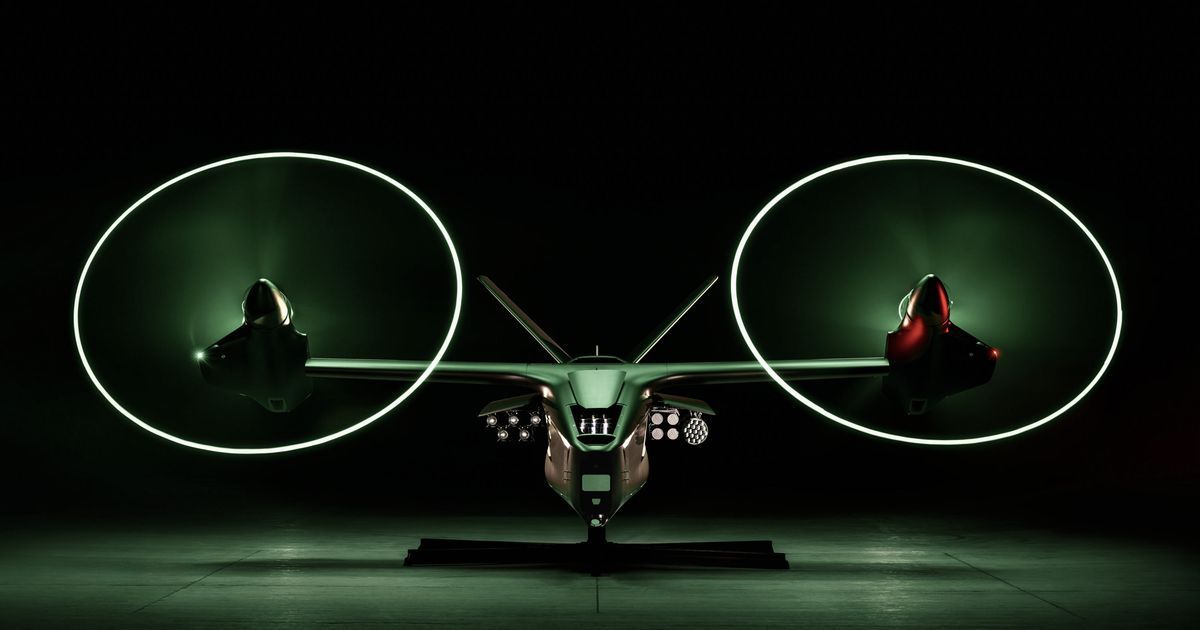
Anduril Industries and Archer Aviation unveiled Thunder on July 20, 2026 at the Farnborough International Airshow — a Group 5 autonomous attack tiltrotor built to fly alongside crewed Apache and Cheyenne helicopters. The 1,320+ lb aircraft carries up to 10 Hellfire missiles or 76 rockets, runs on a hybrid-electric powertrain, and fits inside a standard shipping container. A flight-worthy prototype is targeted for 2027.
Background
Thunder is a Group 5 unmanned aircraft — the US Department of Defense's classification for the heaviest, most capable drone category, covering aircraft over 1,320 lb (599 kg) with no altitude ceiling. Anduril and Archer say the design draws directly on lessons from Ukraine, where cheap, attritable drones have reshaped how ground and air forces fight. Chris Brose, Anduril's chief strategy officer, said Thunder incorporates "lessons that the United States and our European allies are learning in Ukraine," according to Breaking Defense.
The two companies have been working on the airframe for roughly three years, with the autonomy software already flying on surrogate test aircraft for the past two years, Breaking Defense reported. That distinguishes Thunder from a paper concept: the software stack that will eventually fly the production aircraft has logged real flight hours, even though the finished Thunder airframe has not yet taken off.
The program also answers a gap the US Army identified in October 2025, when it said it wanted an autonomous "wingman" aircraft to operate alongside crewed attack helicopters — the rotorcraft equivalent of the Air Force's Collaborative Combat Aircraft program, which pairs autonomous jets like Anduril's YFQ-44A Fury with crewed fighters.
What Thunder Can Carry
Thunder is a tiltrotor: an aircraft with rotors mounted on wingtips that tilt upward for helicopter-style vertical takeoff and landing, then rotate forward for efficient, faster cruise flight like a fixed-wing plane. Anduril and Archer built it around a series hybrid-electric powertrain paired with dual Optimum-Speed Tiltrotors (OSTR) that vary rotor RPM across flight phases — reducing fuel burn in cruise and cutting acoustic signature during low-altitude approach, according to New Atlas.
Per Breaking Defense, Thunder's range and speed are pitched to match the Bell/Boeing-class Cheyenne-type helicopter design, while its payload capacity is comparable to an AH-64 Apache and its service ceiling is higher. The aircraft's modular bay swaps between weapons and non-weapons loads:
| Payload configuration | Capacity |
|---|---|
| Air-to-ground missiles | Up to 10 (Hellfire, Barracuda-100M) |
| Air-launched drones/effects | Up to 16 |
| 70mm rockets | Up to 76 |
| Counter-drone weapons (nose-mounted) | 12 |
| Alternative loads | Precision munitions, electronic warfare pods, general cargo |
At over 1,320 lb, Thunder is compact enough to ship inside a standard 40-foot ISO shipping container, according to New Atlas — a logistics detail the companies emphasize because it lets the aircraft deploy without a dedicated cargo aircraft. The operational concept calls for three to six Thunder units flying in a formation alongside a single crewed Apache or Cheyenne-class helicopter, extending the crewed aircraft's sensor reach and weapons capacity while keeping human pilots farther from the highest-risk part of a mission.
A Dual-Use Platform, and a Market Reaction
Thunder is the defense-focused half of a jointly developed VTOL platform; Archer is building a related hybrid-electric aircraft for commercial and cargo use on shared core technology, according to Archer's investor announcement. That dual-use structure — one hybrid-electric airframe, a military variant and a civilian variant — mirrors how Archer has approached its passenger eVTOL business, and gives the company a second revenue path beyond air taxi service.
Investors reacted immediately: Archer Aviation (NYSE: ACHR) shares jumped as much as 19.6% on the Monday of the announcement, with eVTOL peers Joby Aviation and EHang also trading higher the same day. The reaction reflects a broader shift already underway in Europe and the US, where defense budgets are increasingly funding autonomous aircraft development — the same trend behind Anduril's YFQ-44A missile test earlier this month and rising NATO counter-drone spending.
Anduril and Archer expect a flight-worthy Thunder prototype to fly in 2027, with production entry targeted for the 2029–2030 timeframe.
What This Means for Drone Pilots
Thunder itself is a defense program, not a civilian aircraft — commercial and recreational drone pilots will never fly one. But the propulsion and autonomy technology behind it doesn't stay siloed in defense programs for long. The same hybrid-electric and autonomous flight software racing toward maturity in military tiltrotors tends to migrate into commercial BVLOS operations, larger UAS categories, and eVTOL cargo platforms within a few years, the way DJI's and Autel's autonomy features have historically traced back to research funded for other purposes. For pilots and operators tracking where commercial drone autonomy is headed next, defense-funded programs like Thunder are a leading indicator of what regulators and manufacturers will be building toward later in the decade.
FAQ
Sources: Anduril — Introducing Thunder | Breaking Defense | New Atlas | Archer Aviation investor announcement
More like this
Related Articles

China Drone Export Controls: Motors, Props From Nov 18
China will require export licenses for heavy-lift drone motors, propellers, autopilots and long-range drones from Nov 18. See what…
Ukraine 1,000-Drone Attack on Russia: What We Know
Russia says it downed 1,015 Ukrainian drones in one night as St. Petersburg's oil terminal burned. Here is what happened and what…
Ukraine Drone Evacuates Wounded Soldier in World First
Ukraine says a heavy hexacopter flew a wounded soldier 62 km from the front line, the first drone casualty evacuation. See the spe…