Zuri Unveils Hybrid Cargo VTOL Drone: 679 km Range
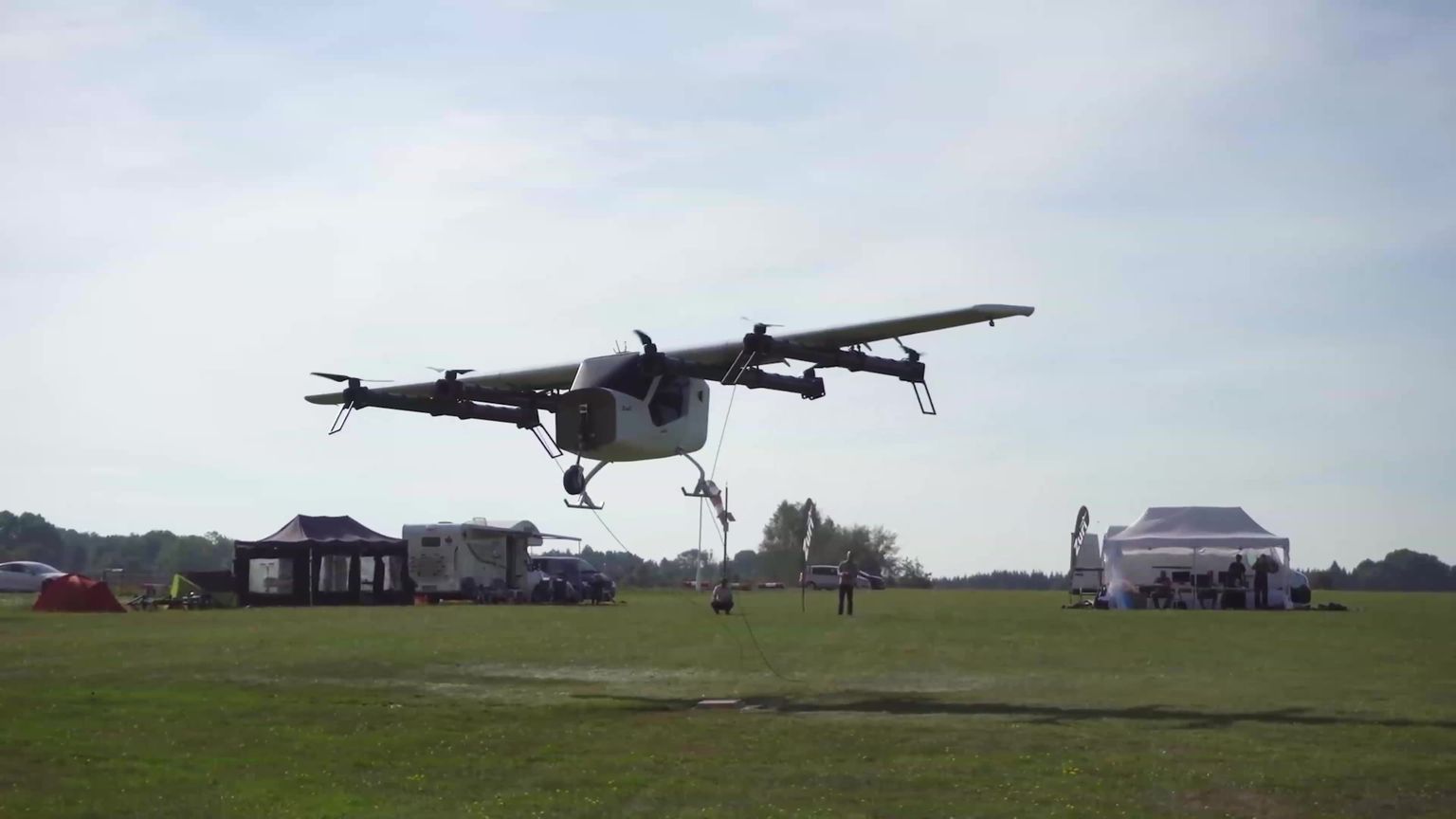
Zuri, a Prague-based aerospace startup, unveiled its uncrewed hybrid-electric cargo VTOL aircraft on August 27, 2026. The tiltrotor carries a 100-plus-kg payload up to 679 km at 220 km/h, lands on a pad, deck, or open ground, and is built ITAR-free on an all-European supply chain for civil and defense resupply missions.
The aircraft is the company's first commercial product after nine years of in-house flight testing, positioning Zuri against a growing field of hybrid-electric cargo drones competing to move heavy loads over long distances without a pilot on board.
Background
Founded in 2017, Zuri has flown more than 15 aircraft and logged hundreds of test flights since 2018, reaching full-scale hover capability in 2021. Its latest aircraft, called Technology Demonstrator 2.0 (TD 2.0), integrates the full production architecture the company plans to sell and is now in systems integration and ground testing at its Prague facility, with flight testing scheduled for early 2027.
A tiltrotor is a VTOL (Vertical Take-Off and Landing) aircraft whose rotors pivot between a vertical position for hovering and a horizontal position for forward flight, combining a helicopter's ability to land in tight spaces with a fixed-wing aircraft's cruising efficiency. Zuri's design pairs that layout with a hybrid-electric powertrain — an onboard generator that produces electricity in flight rather than relying solely on batteries — which the company says delivers roughly 1,500 watt-hours per kilogram at the system level, compared with 230–280 Wh/kg for battery-only eVTOL designs. That gap in energy density is the main reason hybrid-electric aircraft can fly hundreds of kilometers with a heavy payload while pure-battery cargo drones are typically limited to short regional hops.
Specs, Funding and Timeline
Zuri's cargo VTOL is built to carry more than 100 kg of payload, with a useful load — payload plus fuel — of 165 kg. Design range is 679 km, dropping to 569 km when a mandatory 30-minute fuel reserve is factored in, at a cruise speed of 220 km/h. The airframe uses distributed propulsion and redundant fly-by-wire flight controls, and it can land on a prepared pad, a ship deck, or unimproved open ground.
| Spec | Value |
|---|---|
| Payload | 100+ kg (165 kg useful load with fuel) |
| Design range | 679 km (569 km with 30-min reserve) |
| Cruise speed | 220 km/h |
| Landing surfaces | Pad, deck, or open ground |
| Powertrain | Hybrid-electric, ~1,500 Wh/kg system-level |
| Flight testing | Early 2027 |
| Commercial deliveries | 2027–2029 |
Zuri is raising the first €6 million ($6.5 million) tranche of a Series A round, of which €1.1 million is already committed by existing investors, on top of €7.6 million ($8.2 million) raised since the company's founding. Founder and CEO Michal Illich said the company spent nine years building architecture expertise in-house before offering the aircraft to outside operators. Later funding tranches are expected to carry the program from TD 2.0 through the first production airframe and into commercial deliveries between 2027 and 2029.
ITAR-Free Design and EASA Approval Path
Zuri is marketing the aircraft as ITAR-free — meaning it falls outside the US International Traffic in Arms Regulations, the export-control regime that restricts the sale and transfer of US-made defense and dual-use technology. Design, manufacturing, and flight testing all happen in the Czech Republic on what the company calls a sovereign European supply base, a pitch aimed at European civil operators and defense buyers who want to avoid the licensing delays and third-country restrictions that come with US-regulated components.
For certification, Zuri is pursuing approval through the EASA Specific category, using the Specific Operations Risk Assessment (SORA) framework that evaluates each planned mission individually rather than requiring a full passenger-grade type certificate. That per-operation approach is the same regulatory logic used for uncrewed cargo and inspection flights that operate BVLOS (Beyond Visual Line of Sight) today — it lets an aircraft enter limited commercial service years before it could clear the certification bar required to carry passengers.
Two mission sets are driving early interest: civil resupply, such as ferrying parts and supplies to offshore platforms, and defense logistics, moving cargo into austere locations without a runway. Both rely on the aircraft's ability to land without prepared infrastructure.
What This Means for Drone Pilots
Zuri's aircraft sits well above the weight and complexity of the consumer and prosumer drones most PickDrones readers fly, but the program is a signal worth watching for three reasons.
First, it confirms that hybrid-electric propulsion — not pure battery power — is becoming the standard architecture for any drone that needs to move real cargo weight over real distance, a trend also visible in heavier DJI and Autel enterprise platforms. Second, Zuri's EASA Specific/SORA approval path is the same regulatory route that European BVLOS operators of all sizes are using to get uncrewed aircraft flying commercially, so its progress is a useful proxy for how fast that pathway is maturing. Third, the explicit ITAR-free positioning reflects a broader shift among European and Asian manufacturers to market hardware — including consumer drones — as independent of US export and security restrictions, a theme that has also shaped recent FCC and tariff actions against Chinese drone makers in the US market.
Commercial deliveries are not expected before 2027, so there is no near-term operational or regulatory change for licensed remote pilots. Operators focused on infrastructure inspection, agriculture, or public safety should watch whether Zuri or competitors bring a smaller, lower-cost hybrid-electric cargo variant to market once TD 2.0 completes flight testing.
FAQ
Sources: DroneLife | Vertical Magazine
More like this
Related Articles
Zipline Drone Delivery Live in Round Rock, 5,000 Spots
Zipline drone delivery began in Round Rock, Texas on Oct. 9, 2026, with 5,000 early-access spots. Here's who can order, what it co…

FCC Vote on China Test Labs: 82% of Devices (Oct. 29)
The FCC votes Oct. 29 to end recognition of mainland China test labs on Dec. 1, 2028. Here's what the draft order says and what it…

FAA Order 7200.23E: Tower Drones Fly Above LAANC Grids
FAA Order 7200.23E lets Part 107 pilots inspect towers above LAANC grid altitudes without a tower call. Here are the new limits an…