Zipline Drone Parachutes Onto Texas Highway, No Injuries
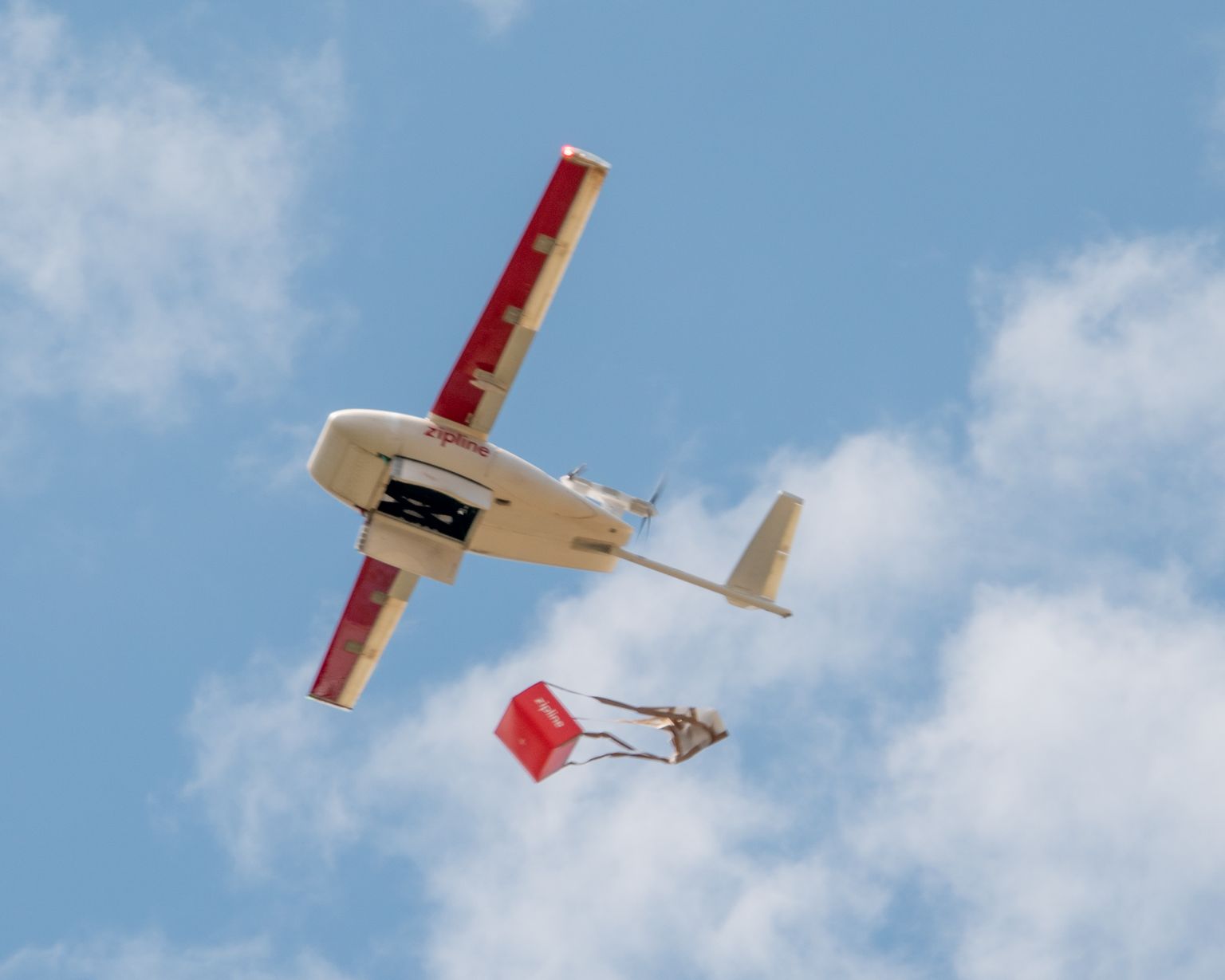
A Zipline delivery drone deployed its emergency parachute and came down in the middle of Highway 6 in Cypress, Texas, on the morning of September 4, 2026, after the aircraft suffered a midflight malfunction. No one was injured and nothing was damaged, according to Zipline and local authorities, and the cause of the failure has not been determined.
Background
Zipline operates one of the largest commercial drone delivery networks in the United States, flying BVLOS (Beyond Visual Line of Sight) routes — flights where the pilot cannot see the aircraft with the naked eye — to drop food, groceries, and medical supplies without the drone ever landing at the customer's address. Instead, its aircraft hover roughly 300 feet up and lower packages on a tethered, self-steering pod.
That kind of autonomous, low-altitude operation over populated neighborhoods only earns regulatory approval because of layered safety systems: redundant propellers and batteries, backup communications links, and — as a last resort — a ballistic parachute that fires if the drone can no longer fly safely. Learn more about how these approvals work in our guide to what BVLOS means for US drone rules.
What Happened in Cypress
The drone came down under parachute on the southbound lanes of Highway 6 near Timber Creek Place Lane in Cypress, northwest of Houston, at around 8 a.m. local time on Friday, September 4, according to Click2Houston. The aircraft was en route to pick up an order — not carrying one — when it encountered what Zipline called a "midflight issue."
Harris County law enforcement told local reporters they never received a single 911 call about a drone sitting in a traffic lane, and no vehicles were damaged. A Zipline spokesperson said the company does not believe weather was a factor, despite storms in the Houston area that day, and that the exact cause is still under investigation.
Zipline's aircraft run more than 500 automated safety checks per second in flight, and the parachute deployment — which the company internally calls a "paraland" — is designed to bring the drone down in a controlled, low-speed descent rather than let it fall uncontrolled.
How Common Are Drone "Paralands"?
Friday's incident was not Zipline's first publicized parachute landing this year. In July 2026, a Zipline drone operating a Walmart delivery route parachuted onto a street in Greenville, Texas, landing a few feet from a parked truck, according to DroneXL. Zipline has described paralands as rare relative to its overall flight volume, which passed 2.5 million lifetime deliveries earlier in 2026.
Parachute recovery systems have become a standard part of BVLOS compliance across the industry, not just at Zipline. DJI's AP100 parachute, for example, was built specifically to let its Matrice 400 drone qualify for European airspace certification that permits flights over populated areas. The logic is the same in both cases: regulators require a proven way to bring a drone down safely if something fails mid-flight, and a working parachute deployment — even one that lands on a highway — is technically the safety system doing its job rather than failing outright.
What This Means for Drone Pilots and the Delivery Industry
For commercial drone operators, the Cypress incident is a reminder that BVLOS approval comes with an implicit trade: regulators accept a small residual risk of mechanical failure in exchange for proven redundancy, logging, and rapid incident reporting. Operators flying under FAA waivers or the emerging Part 108 framework should expect scrutiny of failure-mode data after any public incident, even one that causes no injuries.
For the broader industry, the timing matters. Amazon, Wing, and Zipline are all expanding drone delivery coverage to hundreds of additional US cities and towns in 2026, and each highly visible incident — however minor — feeds public debate over whether delivery drones should keep flying over roads, driveways, and yards. Companies that can show a fast, transparent response, as Zipline did here, are better positioned to keep that expansion on track than companies that stay quiet.
Recreational and Part 107 pilots flying near active delivery corridors should also note that state and local police are increasingly the first responders to drone incidents, not the FAA — so a company's own safety reporting, not a federal investigation, is often the only public account of what went wrong.
FAQ
Sources: Click2Houston | DroneXL
More like this
Related Articles
Ghost Shark Sea Mines and Altius Drone Swarms Unveiled
Australia revealed Ghost Shark payloads on Oct. 19: 12 sea mines, Altius loitering-drone swarms and seabed caches. Here's what the…

China Drone Export Controls: Motors, Props From Nov 18
China will require export licenses for heavy-lift drone motors, propellers, autopilots and long-range drones from Nov 18. See what…
Ukraine 1,000-Drone Attack on Russia: What We Know
Russia says it downed 1,015 Ukrainian drones in one night as St. Petersburg's oil terminal burned. Here is what happened and what…