SiFly Q12 Drone: $20M Funds 90-Mile Long-Endurance UAV
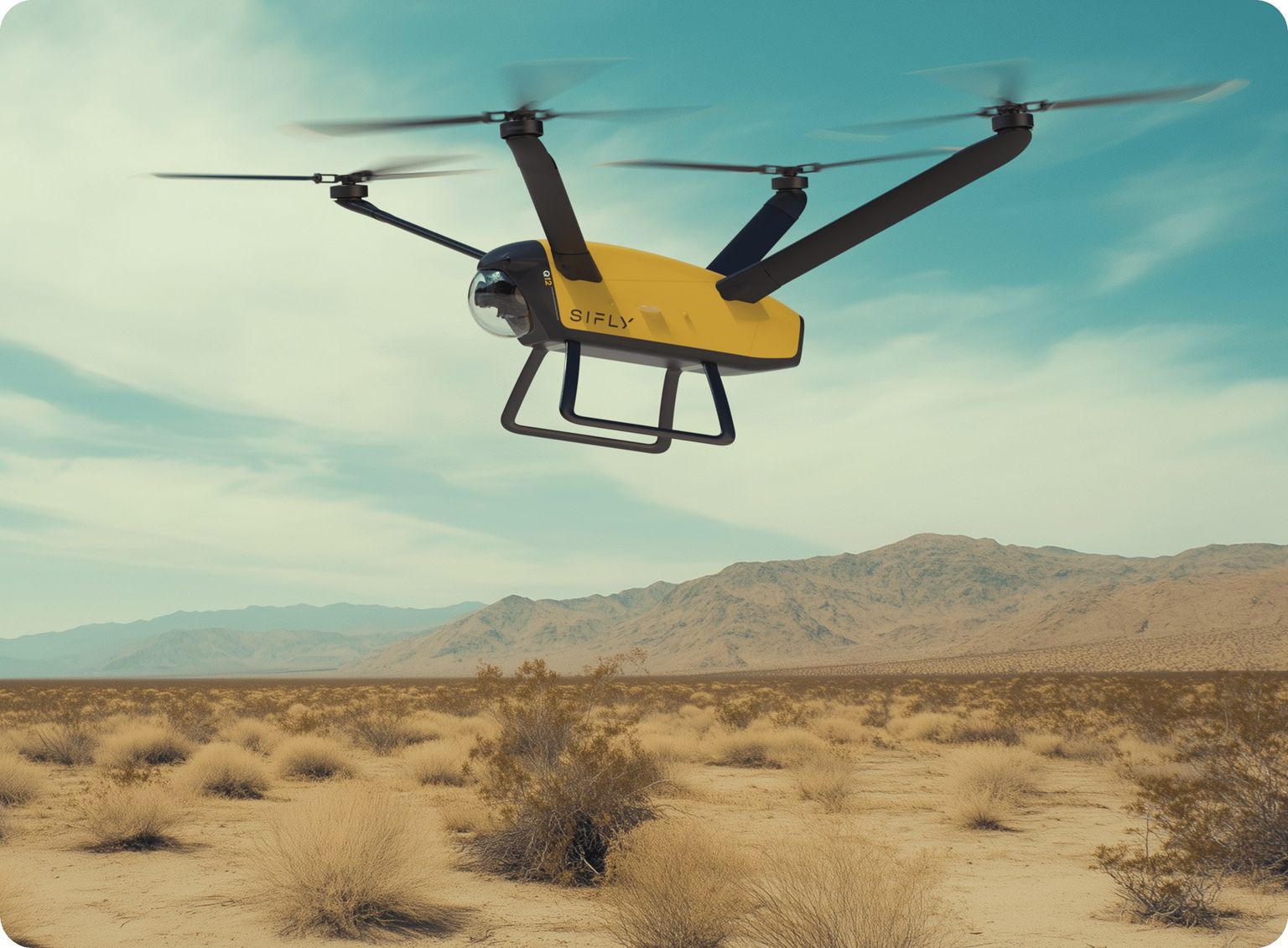
SiFly Aviation raised $20 million in Series A funding on August 26, 2026, to scale U.S. production of its Q12 drone, a hybrid VTOL aircraft that holds a Guinness World Record for the longest flight by an electric multirotor in its weight class. Shield Capital led the round, with Qudit, BBK Capital, and Alumni Ventures also participating.
Background
Most enterprise multirotor drones trade endurance for portability: a typical inspection or public-safety quadcopter flies 20 to 40 minutes and covers a few miles before needing a fresh battery. SiFly, based in Santa Clara, California, built the Q12 to break that trade-off by combining a multirotor's vertical takeoff and landing (VTOL) with a fixed-wing aircraft's cruising efficiency — a configuration sometimes called a hybrid VTOL. Read PickDrones' eVTOL and air taxi guide for how the same hybrid-lift principle scales up to passenger aircraft.
The Q12 takes off and lands like a quadcopter, then transitions to horizontal, wing-borne flight for the cruise portion of a mission. SiFly says this lets the aircraft fly four to five times longer and cover up to 10 times the distance of comparable enterprise multirotors. In July 2025, a Q12 flew for 3 hours, 11 minutes, and 54 seconds over California's Salinas Valley, setting a Guinness World Record for its weight class. The production aircraft has a maximum takeoff weight of 30 pounds (13.6 kg), carries payloads up to 10 pounds, and has a rated range of 90 miles (145 km).
The $20 Million Series A
Shield Capital led the funding round, with participation from Qudit, BBK Capital, Alumni Ventures, and other investors, according to SiFly's press release. SiFly says the capital covers roughly 18 months of runway and will fund production scaling, continued development of its DronePort automated infrastructure system, and regulatory work.
SiFly is negotiating a 15,000-square-foot manufacturing site in Sunnyvale, California, and is targeting first revenue-generating deliveries in the first quarter of 2027, with plans to ship around 1,000 Q12 units that year. That timeline has already slipped once — the original target for first deliveries was the fourth quarter of 2025. "Nobody takes you seriously until units ship," founder and CEO Brian Hinman told DroneXL, acknowledging the credibility gap facing any drone startup before its hardware reaches customers.
DronePort, the company's companion infrastructure product, packs three or four Q12 aircraft into a footprint the size of a 20-foot shipping container — roughly one parking space. Drones land on the roof of the unit and are stored and recharged inside, allowing a single site to support repeated, unattended missions across a wide coverage area.
The Chinese-Motor Question
SiFly is positioning the Q12 as a domestically produced alternative at a moment when U.S. rules are pushing federal, state, and local agencies away from foreign-made drones. The FCC added Chinese-made drones to its Covered List in December 2025, and the NDAA 2023 American Drone Security Act now bars federally funded projects from buying or operating aircraft from manufacturers like DJI and Autel.
Yet the Q12's motors are sourced from China. Hinman told DroneXL that building the motors domestically would roughly triple their cost, and that sourcing the rare-earth magnets they require from U.S. suppliers is "just not physically possible today." The Q12 still qualifies as NDAA-compliant because current rules restrict where a drone's camera and radio components are made — not its motors — leaving a gap in the "Made in USA" framing that SiFly, like much of the industry, is currently exploiting rather than closing.
What This Means for Drone Pilots
For public safety agencies, utility inspectors, and infrastructure operators in the United States, the Q12 is a bet that longer range and flight time can offset a higher upfront cost and an unproven production track record. SiFly is marketing the aircraft directly at agencies now barred from buying Chinese-made drones under NDAA rules, positioning range and endurance — not price — as the pitch. Extended-range missions like these increasingly depend on BVLOS (Beyond Visual Line of Sight) authorization, so operators evaluating the Q12 should factor in the same FAA waiver process that applies to any long-range drone program.
Outside the U.S., the Q12 is a useful data point on where the industrial drone market is heading: hybrid VTOL designs that stretch mission range well past what standard quadcopters can manage, aimed at the same public-safety, utility, and agricultural customers PickDrones covers globally. SiFly says a heavier-lift variant, the Q250, is already in design for agricultural spraying, cargo, and firefighting work.
FAQ
Sources: SiFly Series A press release, PR Newswire | DroneXL
More like this
Related Articles
DJI Phantom 4 Pro V2 Service Ends Oct. 31: Owner Guide
DJI ends Phantom 4 Pro V2 repairs and support on Oct. 31, 2026. Here is what stops, what still works, and what owners should do be…
Zipline Drone Delivery Live in Round Rock, 5,000 Spots
Zipline drone delivery began in Round Rock, Texas on Oct. 9, 2026, with 5,000 early-access spots. Here's who can order, what it co…
FCC Vote on China Test Labs: 82% of Devices (Oct. 29)
The FCC votes Oct. 29 to end recognition of mainland China test labs on Dec. 1, 2028. Here's what the draft order says and what it…