Leipzig Airport Drone Bomb: Semtex Confirmed, DHL Hit
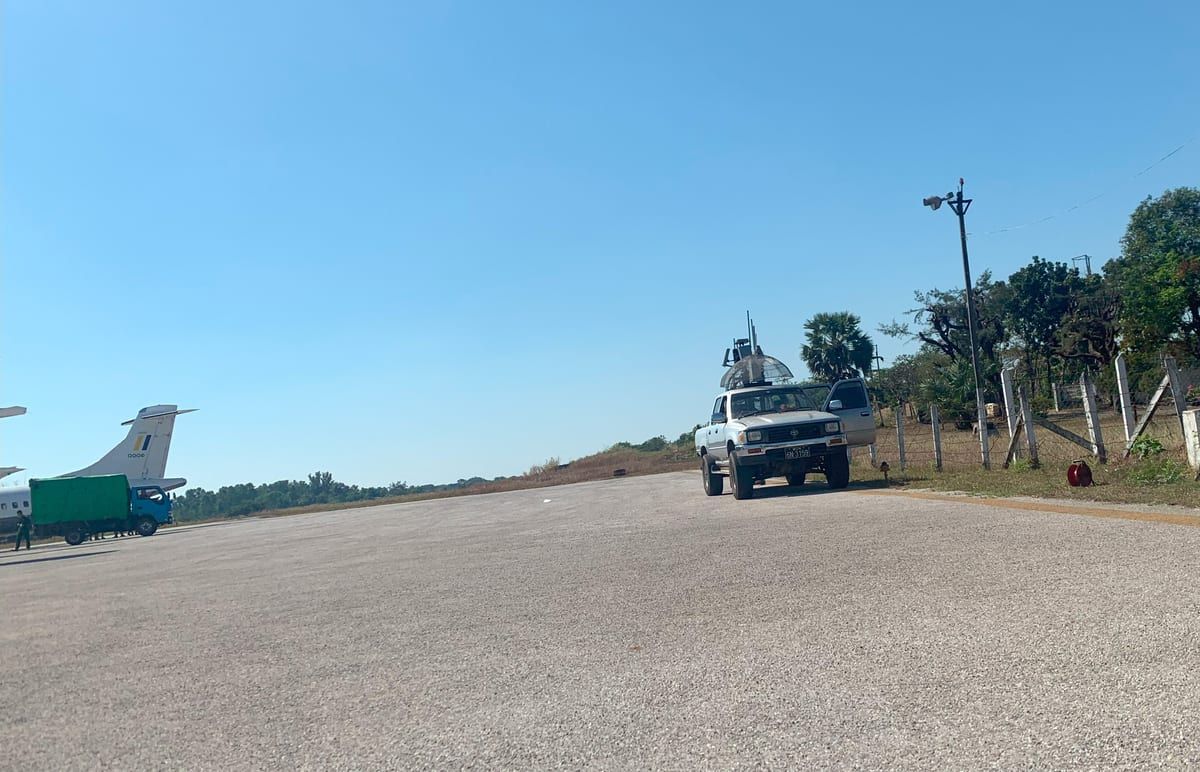
A modified drone carrying a Semtex plastic explosive and a detonator was found on the tarmac at Leipzig/Halle Airport in Germany late on August 4, 2026, meters from a parked Ukrainian Antonov An-124 cargo plane. Investigators confirmed the Semtex finding on August 6. A separate DHL freighter was struck by an unidentified object near the airport the same night, forcing an emergency diversion to Hannover.
Background
Leipzig/Halle Airport is one of Europe's busiest cargo hubs and a regular transit point for Ukrainian and NATO military logistics, making it a recurring target for suspected sabotage since Russia's full-scale invasion of Ukraine. German officials blamed a 2024 incendiary-device attack at the same airport on Russian intelligence, and Western security services have accused Moscow of staging dozens of similar incidents across Europe over the past two years.
Semtex is a plastic explosive originally developed in Czechoslovakia, valued by both militaries and bomb-makers for its stability, moldability, and resistance to accidental detonation — properties that also make it attractive for concealment inside small drones. The same compound has been used in past aviation terror plots, which is part of why its confirmation at an active airport apron immediately escalated the case from a security scare to a criminal investigation led by counter-extremism prosecutors.
What Happened at Leipzig/Halle
An airport employee spotted the unidentified object on the airport's south runway shortly before midnight on August 4. German federal police cordoned off the area, and an X-ray scan confirmed it was a modified quadcopter carrying an explosive payload with a detonator attached. A bomb-disposal robot was deployed, and officers safely removed the detonator.
The drone was found close to a Ukrainian Antonov An-124 Condor, operated by Antonov Airlines, parked on the apron in its national livery. Authorities have not confirmed whether the aircraft was the intended target, but Leipzig/Halle is a primary transit point for Ukrainian and Allied military cargo in Europe.
On August 6, investigators told the German press agency dpa that laboratory analysis confirmed the explosive material was Semtex, updating earlier reports that had described the device only as improvised. The south runway was closed for roughly two hours during the response, and several flights — including a passenger service arriving from Mallorca — were diverted.
The DHL Aircraft Collision
Hours after the drone was discovered, a separate DHL cargo aircraft collided with a suspected drone or unidentified object roughly 6 kilometers from the airport while maneuvering around the security closure. The freighter sustained minor damage to its nose section but landed safely at Hannover Airport, about 125 miles (200 km) northwest of Leipzig. No injuries were reported. Investigators have not confirmed whether the two incidents are connected.
Investigation and Official Response
The case has been taken over by the Dresden Public Prosecutor General's Office, the Central Office for Extremism Saxony, and the Saxony State Criminal Police Office — the units responsible for politically motivated and extremist crimes in Germany. No suspects have been identified.
German Interior Minister Alexander Dobrindt called the incident "a new quality of threat," warning that an explosive-armed drone reaching an active airport represents a new hybrid-attack scenario for aviation security. A federal police spokesperson said the overflights could plausibly have been organized by Russian state actors, though a separate Interior Ministry spokesperson cautioned that no confirmed link to the DHL collision has been established.
Aviation security expert Hartmut Fricke told German media the episode exposed a gap in how well airports detect small, slow-moving objects like drones around parked aircraft and cargo aprons — a blind spot distinct from tracking a fast-moving airborne intruder. He noted that a drone sitting stationary on an apron for hours, as this one apparently did, is a different detection problem than a transient airborne track: it should, in principle, be catchable by routine surface-movement radar and ground patrols independent of any dedicated counter-drone system, which is why the miss is drawing scrutiny of Leipzig/Halle's basic perimeter security, not just its anti-drone technology.
What This Means for Drone Pilots
The incident is likely to accelerate counter-drone investment at airports across Europe and beyond, alongside tighter enforcement of existing no-fly zones around airports. Legitimate operators flying near any airport, in Germany or elsewhere, should expect heightened scrutiny, faster law-enforcement response to unauthorized flights, and less tolerance for drift into restricted airspace even by accident.
For pilots operating in the EU, the case underscores why compliance with EASA's drone category rules — including geo-awareness and remote identification — matters beyond avoiding a fine: unidentified drones near critical infrastructure are now treated as a potential security threat first and a regulatory infraction second. Airports worldwide are watching Leipzig/Halle as a case study in how quickly a single incident can reshape local airspace restrictions.
Germany's own airspace-security law already lets the armed forces down a drone when it is the only way to prevent a "particularly severe disaster," following a February 2026 amendment to the country's aviation security statute. Expect similar emergency powers, along with mandatory drone-detection systems at major airports, to move up the legislative agenda in other EU states and in the UK over the coming months — even for hobbyist pilots who have nothing to do with sabotage, that typically means stricter no-fly buffers and steeper penalties for any incursion near an airport perimeter.
FAQ
Sources: NPR | Reuters via Insurance Journal
More like this
Related Articles
EASA Proposes Cutting Drone Registration to 100g in 2026
EASA's new Opinion 06/2026 would drop the EU drone registration and Remote ID threshold from 250g to 100g, matching the UK. Here's…
Flytrex Drones Now Predict Your Order Before You Do
Flytrex's rooftop drone docks and AI positioning system now predict food orders before they're placed, cutting delivery costs 60%…
Drone Halts Flights at Reagan National for 20 Minutes
An unauthorized drone forced a 20-minute halt of all Reagan National Airport flights on Sept. 16, 2026 — here's what happened and…