DJI Air 3
The DJI Air 3 has dual cameras (wide + 3× tele), a 1/1.3" sensor, omnidirectional obstacle avoidance and 46 min flight time. Full specs and Air 3S comparison.
Price (USD)
$1,099
Full Specifications
| Weight | 720 g |
| Flight Time | 46 min |
| Max Speed | 75.6 km/h |
| Camera | CMOS 1/1.3", 48 MP (wide) + CMOS 1/1.3", 12 MP (3× tele) |
| Video | 4K/60fps, D-Log M, HDR |
| Obstacle Avoidance | Omnidirectional APAS 4.0 |
| Max Range | 20 km (FCC) |
| Wind Resistance | Level 6 (33 mph) |
| GPS | GPS + GLONASS + BeiDou + Galileo |
| Charging Time | 55 min (35W charger) |
| Dimensions | 207 × 100 × 84 mm (folded) |
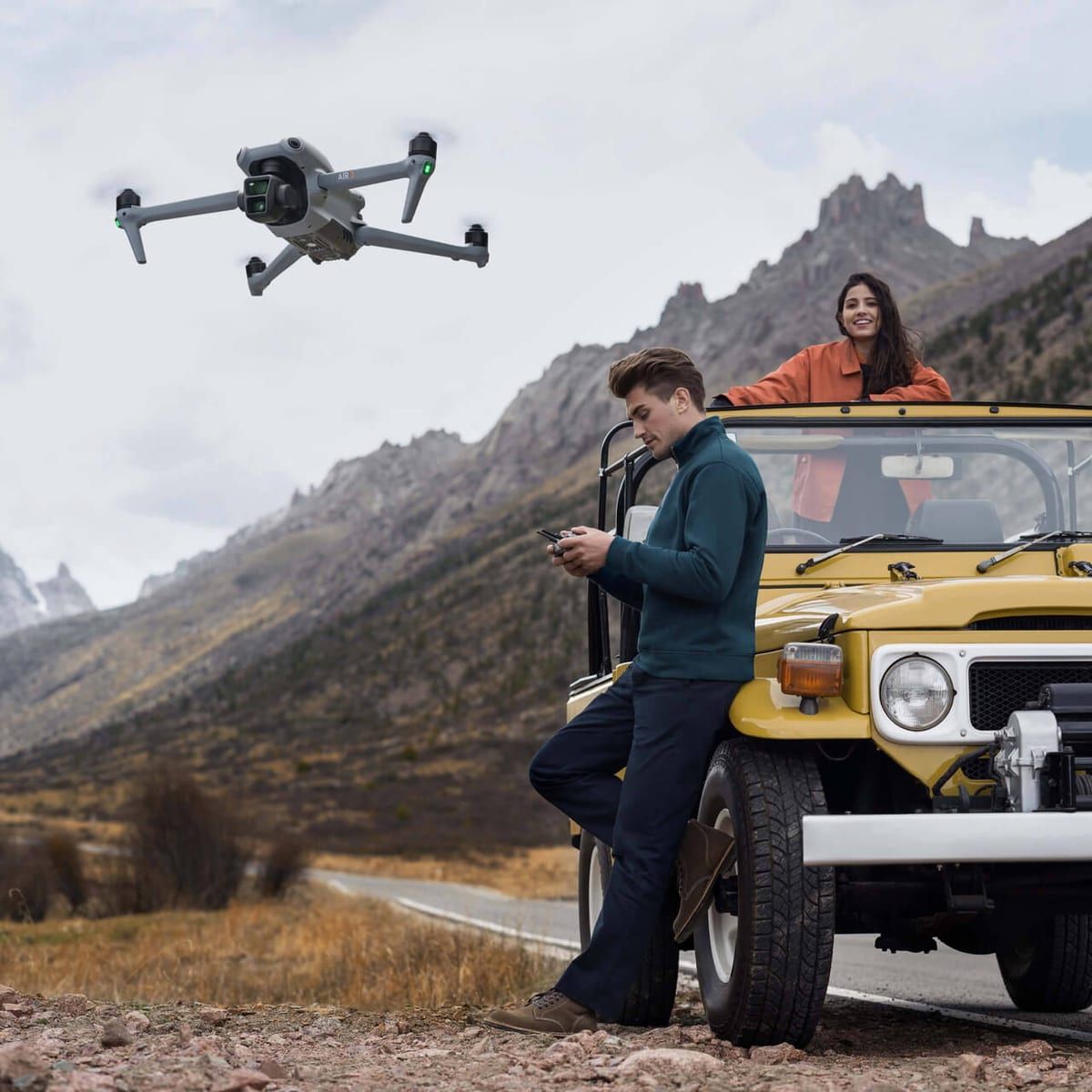
Launched in July 2023, the DJI Air 3 brought dual-camera capability to the Air line: a 1/1.3" wide (48 MP) and a 3× telephoto (70mm equivalent, 12 MP) in the same 720g drone, with omnidirectional obstacle avoidance. Previously, having two distinct focal lengths in the field meant carrying two drones.
The arrival of the Air 3S in 2024 with a one-inch sensor positioned the Air 3 as the more affordable option in the line, but it remains relevant for its excellent camera quality in standard lighting conditions.
Quick specs (official DJI data): The DJI Air 3 weighs 720 g, flies up to 46 minutes per charge, shoots 4K/60fps on dual 1/1.3" sensors (48 MP wide + 12 MP 3× tele), and offers omnidirectional obstacle avoidance (APAS 4.0) with up to 20 km of O4 transmission range. Every figure below matches DJI's official spec sheet, linked in the sources at the bottom of this page.
Dual Camera System
The wide camera (1/1.3", f/1.7, 48 MP) delivers images with good dynamic range and excellent performance up to ISO 800. The tele camera (1/1.3", f/2.8, 70mm equivalent, 12 MP) has the same sensor size as the wide, compensating in reach what it loses in aperture.
Both cameras shoot 4K/60fps with D-Log M support (10-bit). Simultaneous dual-camera recording is not supported (that's exclusive to the Air 3S). The pilot switches between cameras manually in the app.
Active Track 4.0 works with both cameras, including zoom tracking: the drone keeps subjects in frame using the tele camera for perspective compression.
APAS 4.0 Obstacle Avoidance
APAS 4.0 with all-direction detection navigates autonomously around moderate-density obstacles. Compared to the APAS 5.0 in the Air 3S, performance in dense vegetation is slightly lower, but for most everyday use the difference is marginal.
46 Minutes: What to Expect
DJI rates the Air 3 at 46 minutes; independent reviewers and owners report roughly 32 to 38 minutes per flight in real-world use, with 3 to 5 m/s wind at 20 to 25°C ambient temperature. The Fly More Combo Plus includes three batteries, charging hub, and carry bag, ideal for longer sessions where battery swapping isn't practical.
Air 3 vs. Air 3S
The Air 3S ($1,099 at launch) has a one-inch sensor on the main camera (better low-light performance), APAS 5.0, simultaneous dual-camera recording, and Level 7 wind resistance. For daytime shooting in good conditions, the Air 3 delivers equivalent quality at a lower price. For professional low-light or night work, the Air 3S justifies the additional cost.
Who It's For
The Air 3 suits hobbyists, travel creators, and real estate or event shooters who work mostly in daylight and want dual-focal-length flexibility without paying for a one-inch sensor they won't fully use. Its 720g weight and 46-minute rated flight time also make it a practical choice for longer outdoor sessions when paired with the Fly More Combo Plus's extra batteries.
If your work depends on low-light or night footage, or you need simultaneous dual-camera capture for events, the Air 3S is the better fit at the same price point the Air 3 launched at.
FAQ
Sources: DJI - Air 3 specs