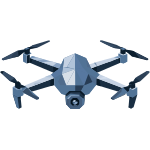
How Does a Drone Work? Motors, GPS & Flight Controller

How does a drone work? The honest answer is: it's simpler than it looks on the surface, and infinitely more sophisticated than its appearance suggests. A modern quadcopter is an embedded system executing thousands of calculations per second, reading half a dozen sensors simultaneously, and translating all of that into minute speed variations across four motors, so the pilot can simply move a joystick and get smooth, predictable movement through the air.
Quick answer: a drone works by spinning four motors that turn propellers in opposite directions; a flight controller reads sensors (gyroscope, accelerometer, GPS, and barometer) thousands of times per second and adjusts each motor's speed to hold stability, altitude, and direction according to the pilot's commands.
Understanding how a drone works isn't just technical curiosity. For anyone who buys, maintains, or operates a drone, this knowledge changes how you diagnose problems, calibrate equipment, and make decisions in the field. This article breaks down the system layer by layer: from motor to battery, from sensor to software.
The Essential Components of a Drone
Before diving into each part, it helps to have the full picture. A typical quadcopter drone consists of:
- Frame: the structural chassis that holds everything together, usually made of carbon fiber or injection-molded plastic
- Brushless motors: four units, two pairs rotating in opposite directions
- ESCs (Electronic Speed Controllers): one per motor, controlling rotational speed
- Flight controller: the central processor that reads sensors and commands the ESCs
- Inertial sensors: gyroscope and accelerometer, sometimes magnetometer and barometer
- GPS: geographic positioning module
- LiPo battery: main power source
- Radio receiver: receives commands from the remote controller
- Camera and gimbal (optional): stabilized image capture system
DJI integrates all of these components into polished products where the user never needs to think about the underlying architecture. In the FPV world and custom drone building, each of these elements is selected and configured individually.
Brushless Motors: Why They're Better
The name "brushless" means exactly that: without brushes. The brushes that don't exist are the ones that would be needed to transfer electricity to a rotating rotor in a conventional (brushed) motor. Brushed motors use carbon brushes that make physical contact with the rotating commutator, creating friction, wear, and limiting efficiency.
Brushless motors eliminate that physical contact by using electromagnetism differently: the coils sit in the stator (the fixed part), and the rotor with permanent magnets spins around them, driven by electronic commutation handled by the ESC. The result is a motor that can last tens of hours of operation without significant mechanical wear, generates less heat, and converts electrical energy to mechanical energy with far superior efficiency.
In practical terms: a brushless motor for FPV drones can spin at over 40,000 RPM and respond to speed changes in milliseconds. For the aircraft to remain stable, that response speed is just as critical as raw power.
The ESC: The Translator Between Brain and Motors
The ESC (Electronic Speed Controller) sits between the flight controller and the motor. It receives a target speed signal from the flight controller and manages the electrical current delivered to the motor to achieve exactly that speed.
Modern ESCs operate at update frequencies ranging from 500 Hz on basic models to 32,000 Hz on the most advanced. This frequency, called PWM frequency or, in newer digital protocols, loop rate, determines how quickly the ESC can respond to command changes. In high-performance FPV drones, ESCs running at 32 kHz allow the aircraft to correct its position dozens of times per second, something imperceptible to the pilot but decisive for stability in aggressive maneuvers.
High-performance modern ESCs use FOC (Field Oriented Control), a more sophisticated motor control algorithm than simple speed control. FOC maximizes efficiency across all operating ranges and reduces heat buildup, especially under high-load flight conditions.
The Flight Controller: The Brain of the Machine
If the motors are the muscles and the sensors are the nerves, the flight controller (FC) is the drone's brain. It's a board with a microprocessor doing one thing in a continuous loop: read all available sensors, compare the reading with the desired state, and send corrections to the ESCs hundreds or thousands of times per second.
The complete cycle, read sensors, calculate correction, send command, is called the "control loop" or PID loop (Proportional-Integral-Derivative). The PID algorithm is the control mathematics that determines how much the drone should correct based on current error, accumulated error, and the rate of change of error. Adjusting the PID gains, a process known as "tuning," is the art of making a drone fly smoothly instead of oscillating or responding jerkily.
Flight controllers range from simple chips embedded in toy drones to high-performance processors like the STM32H7 used in top-tier FPV controllers. DJI drones use proprietary controllers highly optimized for each platform. In the open-source ecosystem, Betaflight, ArduPilot, and PX4 are the most common firmware options, each with different philosophies for different applications.
Gyroscope and Accelerometer: The Physics of Stability
The gyroscope measures angular velocity, specifically how quickly the drone is rotating on each of the three axes (pitch, roll, and yaw). The accelerometer measures linear acceleration on those same axes. Together, these two sensors form the IMU (Inertial Measurement Unit), the heart of stabilization.
In modern flight controllers, the IMU is updated at 1,000 Hz or more, a thousand times per second. Each reading feeds the PID algorithm that decides how much to adjust each motor. This speed of reading and response is what allows a quadcopter to remain stable in wind and turbulence conditions that would be impossible to compensate for manually.
How does a drone work in practice? Imagine a gust of wind pushing the right side of the quadcopter upward. The gyroscope detects the tilt instantly. The flight controller calculates the necessary correction: increase the speed of the right-side motors and reduce the left-side motors. This happens so fast that the pilot barely notices the disturbance, and the drone simply "absorbs" the turbulence.
The magnetometer (electronic compass) complements the IMU by measuring orientation relative to Earth's magnetic field. It's essential for GPS-assisted flight modes, where the drone needs to know its absolute orientation to move in the right direction when the pilot pushes the joystick "forward."
GPS: How the Drone Knows Where It Is (and Comes Home)
The GPS module in a drone works exactly like the one in your smartphone, but with direct integration into the flight control system. By locking onto multiple satellites, the module calculates geographic position with 1–3 meter accuracy in standard GPS mode. With GLONASS, Galileo, and BeiDou added, modern receivers achieve sub-meter accuracy under ideal conditions.
This position information enables the features that defined the consumer drone market:
Position Hold: the drone maintains horizontal position automatically, even in wind. The pilot releases the joysticks and the aircraft simply stops. The controller continuously compares the current GPS position with the target position and commands the motors to correct any deviation.
Return to Home (RTH): when the battery reaches a critical level or the radio link with the controller is lost, the drone records the takeoff position and automatically returns to it. More sophisticated systems, like DJI's, calculate the return route while avoiding obstacles using dedicated cameras and sensors.
Autonomous missions: with GPS, it's possible to program waypoints and the drone executes the route on its own, the foundation of all aerial mapping, infrastructure inspection, and agricultural monitoring.
The barometer complements GPS for altitude control: it measures atmospheric pressure and estimates altitude with ±1–2 meter precision, much faster than GPS can update vertical position. Indoors, where GPS doesn't work, optical flow cameras substitute for positioning. Systems like DJI's Vision Positioning use downward-facing cameras to maintain stable position.
The LiPo Battery: Power and Care
The LiPo (Lithium-Polymer) battery isn't specific to drones, but has become the industry standard for one clear reason: no other rechargeable battery technology combines high energy density with high discharge capacity quite as well.
Each LiPo cell has a nominal voltage of 3.7V, with maximum charge of 4.2V and minimum safe discharge of 3.0V. Below that, the cell begins to degrade irreversibly. Consumer drones typically use 3S (3 cells in series, ~11.1V nominal) to 4S (14.8V) batteries. High-performance FPV drones reach up to 6S (22.2V). The DJI Mini 4 Pro uses proprietary smart batteries at 7.38V (effective 2S with high-voltage LiPo chemistry).
The discharge rate is measured in "C": a 1000mAh battery with a 50C rating can supply up to 50A of peak current without damaging the cells. This rapid discharge capability is what enables the current spikes generated when motors accelerate abruptly during aggressive maneuvers.
LiPo battery care is an essential part of operating any drone. Storing batteries charged above 80% for long periods degrades the cells. Allowing discharge below 3V per cell is destructive and can create fire risk. Charging with balancing chargers that equalize the charge of each cell is standard practice.
How a Quadcopter Moves on All 3 Axes
The elegance of the quadcopter design lies in how complex movements emerge from a simple variable: the relative speed of four motors. The four rotors are arranged in two pairs with opposite rotation directions, with diagonally opposite motors spinning in the same direction. This cancels reaction torque: without this compensation, the drone would rotate around the vertical axis every time the motors accelerated.
Yaw (rotation on the vertical axis): increasing the speed of the two clockwise-spinning motors and reducing the two counterclockwise ones creates net torque that makes the drone rotate. The body rotates, but altitude is maintained.
Pitch (forward tilt): increasing the speed of the two rear motors and reducing the two front ones makes the drone tilt forward. A tilted aircraft directs part of its thrust toward horizontal propulsion, and the drone moves forward.
Roll (lateral tilt): the same principle, but with the lateral pairs: increasing the left-side motors and reducing the right-side ones tilts the drone to the right.
Altitude: increasing or reducing all four motors equally ascends or descends without changing orientation.
In practice, any maneuver is a simultaneous combination of these four variables, and the flight controller calculates that combination every millisecond to respond to the pilot's input. It's exactly this system that makes both the automatic stable flight of a consumer drone and the radical maneuvers of an FPV racer possible in the hands of an experienced pilot.
FAQ
Sources: Oscar Liang: How does a quadcopter work | GetFPV: Flight Controller guide | DJI: Technology
More like this
Related Articles

Drone Remote ID Explained: Do You Need One in 2026?
Remote ID is a digital license plate for drones. See who needs it in the US, UK and EU, the 3 ways to comply, module costs and the…
Best Cheap Drones With Camera in 2026: 6 Picks Under $500
Looking for a cheap drone with a good camera? We compare 6 budget picks from $149 to $450 by real flight time, gimbal, rules and h…
How High Can a Drone Legally Fly? Limits by Country (2026)
The FAA caps drones at 400 feet; the EU, UK and Australia cap them at 120 meters. See the exact legal limit for your country and w…