Frank Wang and DJI: How One Company Dominated Drones
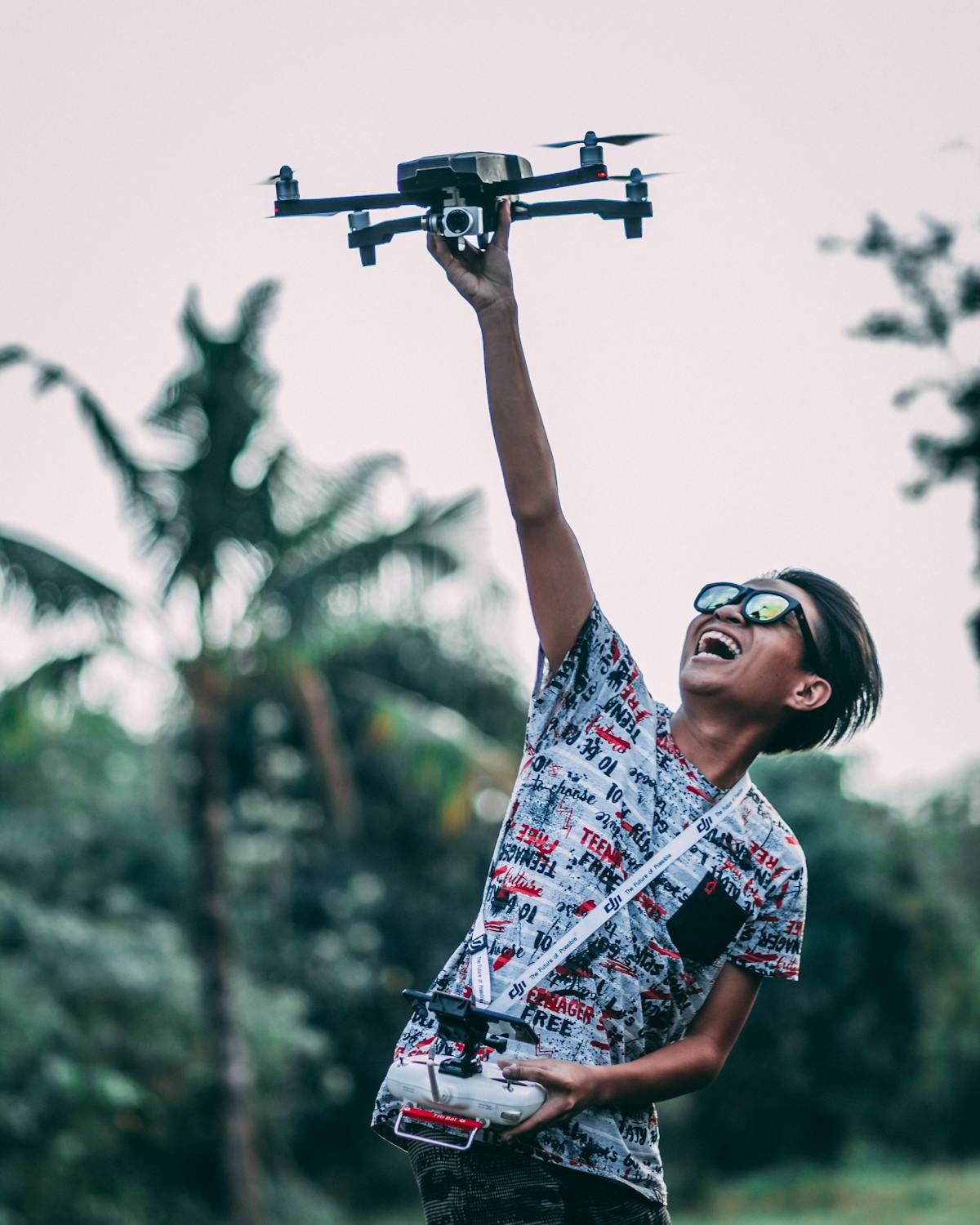
When you think of a drone, you think of DJI. The association is so automatic it feels natural - but nothing about it is accidental. The history of DJI is the story of a company that didn't just create a market but defined it so completely that competitors spent years trying to explain why their products weren't the same as the Chinese standard. It's also the story of an engineering student obsessed with remote-control helicopters who, with no capital, no network, and no business experience, turned a Shenzhen dorm room into one of the world's leading technology companies.
Frank Wang and the Dream That Started in a Dorm Room
Wang Tao - known in the West as Frank Wang - was born in Hangzhou, in China's Zhejiang province. From childhood, he was fascinated by remote-control helicopters, the kind of obsession most parents dismiss as a passing phase. In Wang's case, it never passed.
In 2003, Wang enrolled at HKUST - the Hong Kong University of Science and Technology - to study electronic engineering. The academic environment gave him the tools to turn his obsession into a technical project. Still a student, he developed flight controllers for RC helicopters and won prizes in university product design competitions. His interest wasn't just in flying: it was in solving the stability problem that made RC helicopters so notoriously difficult to pilot.
In 2006, Wang founded DJI - Da-Jiang Innovations, which translates roughly to "vast fields" in Mandarin - out of a dorm room at HKUST. His first employees were college friends. The starting capital was minimal. The product: flight control systems for RC helicopters.
The choice of Shenzhen as the permanent headquarters was no accident. The city is the global capital of hardware - an ecosystem where electronics component manufacturers, manufacturing companies, raw material suppliers, and specialist engineers are a short subway ride away from each other. For an early-stage hardware company, that environment is an unmatched velocity multiplier.
The Early Years: Flight Controllers for Hobbyists
In its first years, DJI operated in a narrow niche: supplying flight controllers to advanced hobbyists and to universities researching unmanned aerial vehicles. It was a small, technical market dominated by enthusiasts who built their own equipment.
DJI's core product in this period was the WooKong-M, a stabilization system for hexacopters and octorotors used mainly by professional photographers who needed stable aerial platforms for heavy cameras. It was good - technically very good - but required specialized knowledge to install, calibrate, and operate. The market was restricted by design.
Wang understood that the barrier to entry was the central problem. For most people, the idea of having a camera drone was appealing. The reality of assembling and calibrating a custom hexacopter was enough to eliminate 99% of interested buyers before they ever reached a first flight.
The answer to that problem arrived in 2013.
The Phantom Changes Everything
The launch of the DJI Phantom in 2013 was a watershed moment not just for DJI but for the drone market as a whole. The Phantom was the first truly "plug and fly" consumer drone - take it out of the box, charge the battery, power it on, and fly. No assembly, no complex calibration, no technical background required.
The integrated camera - or, in early versions, the mount for a GoPro - completed the package. For the first time, anyone could put a camera 300 feet in the air and record footage that previously required rented helicopters at staggering cost.
The impact was immediate. Photographers, filmmakers, journalists, real estate agents, construction firms - all saw a specific application for their work. The Phantom wasn't just a toy. It was a professional tool at a consumer price.
To understand the scale of the shift, consider the competitive context of 2013. Parrot, the French company that was the main reference in consumer drones before the Phantom, sold the AR.Drone at a similar price but with radically inferior capabilities: no reliable GPS, no support for professional cameras, and notoriously unstable in wind. The Phantom wasn't just better - it was better across every relevant dimension simultaneously.
The Phantom's success funded DJI's expansion. The company grew rapidly, hiring engineers, expanding its product line, and reinvesting heavily in R&D. The growth trajectory would turn exponential in the years that followed.
The Mavic and the Era of the Pocket Drone
If the Phantom democratized access to aerial photography, the Mavic Pro, launched in 2016, democratized portability. The Mavic was DJI's first genuinely compact foldable drone - comparable in size to a water bottle, with arms and propellers that fold down to reduce transport volume.
On paper, it sounded like a compromise. In practice, it was a revolution. The Mavic carried a 4K camera with a 3-axis integrated gimbal - the same level of stabilization and quality as the Phantom 4, in a platform that fit in a small backpack. The OcuSync video transmission system delivered stable signal at ranges of several kilometers.
The Mavic Pro sold millions of units and established a design template the entire industry proceeded to follow. Competitors tried to replicate the combination of compactness, camera quality, and stability, but none came close to DJI's execution at that moment.
The Mavic line has evolved continuously: Mavic Air, Mavic 2 Pro (with Hasselblad sensor), Mavic 3, Mavic 4 Pro - each generation adding computational power, camera quality, and safety features. In parallel, DJI launched the Mini series, weighing under 249 grams to qualify for more permissive regulatory categories in many countries. The Mini SE, Mini 3, and Mini 4 Pro opened the market to users who needed a simple, light drone with less regulatory complexity.
Market Dominance: From Chinese Company to Global Standard
DJI's market numbers in 2024 are difficult to process. The company controls more than 70% of the global commercial drone market and more than 90% of the consumer market, according to industry-compiled data. That level of market concentration is uncommon even in mature industries - in consumer technology, it is exceptionally rare.
DJI's valuation is estimated at approximately $15 billion. Frank Wang, now in his early 40s, is a billionaire. The company employs tens of thousands of people globally and operates research centers in China, Europe, and the United States.
How did a company founded in a university dorm room with a product for a hobbyist niche get here? Part of the answer lies in consistent technical execution - DJI rarely ships products with serious defects, and when it does, it responds quickly. Part lies in iteration speed - the company launches new product generations at a pace competitors simply cannot match. And part lies in the ecosystem DJI has built: integration with mapping software, open APIs for developers, fleet management platforms - all of which create switching costs that make moving to competitors not just technically inferior but operationally disruptive.
DJI has also expanded well beyond drones. The Osmo line of action cameras and stabilizers competes directly with GoPro. The Ronin line of gimbals is standard in professional film productions. The DJI Agras is the leading reference in agricultural spraying drones. The Inspire line and Zenmuse cameras are used in Netflix and major broadcast productions worldwide.
The Controversy: US Restrictions and Security Questions
DJI's global success came with a structural problem the company has not fully resolved: growing distrust from the United States toward Chinese technology companies with access to data from American citizens and infrastructure.
In 2020, the Department of Defense added DJI to a list of companies with alleged ties to the Chinese military. In 2021, the Department of Commerce added DJI to the "Entity List," imposing restrictions on exports of American technology to the company. The NDAA (National Defense Authorization Act) formally prohibited the use of DJI drones by US government agencies.
The central accusations: that DJI drones could transmit collected data - images, GPS coordinates, flight information - to servers in China, potentially accessible to the Chinese government. DJI categorically denied the accusations, opened its code to independent audits, and offered a "Local Data Mode" that completely disables data transmission to external servers. The FCC has continued discussions about an even broader prohibition.
One important detail: no independent audit to date has found evidence of clandestine data transmission. The US restrictions on DJI involve as much geopolitics as proven technical security concerns. That doesn't change the practical reality - several US government agencies have replaced or are replacing DJI drones with US-made alternatives such as Skydio - but it contextualizes the nature of the conflict.
For private and commercial users in the US, DJI drones remain legal to purchase and operate. The restrictions apply specifically to US government agencies under the NDAA. Many commercial operators - photographers, inspection companies, agricultural firms - continue to use DJI equipment without legal impediment.
What's Next
DJI continues to invest heavily in areas that go beyond consumer drones. Autonomous navigation systems, 5G network integration for beyond-visual-line-of-sight control, and swarm management platforms are active research fronts. The company is also investing in electric aircraft systems for urban air mobility - the next technological leap in the sector.
The geopolitical question, however, represents a real long-term risk. If the US restrictions deepen and other Western countries follow - the European Union has been watching the American debate closely - DJI could lose access to significant markets. The company is building technical reserves and seeking to expand its presence in non-Western markets as a hedge for that scenario.
But whoever built 70% of a global market from a dorm room probably has answers to questions that haven't been asked yet. The history of drones shows that the sector has always found a path forward - and DJI, so far, has always been at the front.
FAQ
Sources: Wikipedia - DJI | Heliguy - DJI: Two Decades of Innovation | Bloomberg - The Drone King
More like this
Related Articles
Drone Remote ID Explained: Do You Need One in 2026?
Remote ID is a digital license plate for drones. See who needs it in the US, UK and EU, the 3 ways to comply, module costs and the…
Best Cheap Drones With Camera in 2026: 6 Picks Under $500
Looking for a cheap drone with a good camera? We compare 6 budget picks from $149 to $450 by real flight time, gimbal, rules and h…
How High Can a Drone Legally Fly? Limits by Country (2026)
The FAA caps drones at 400 feet; the EU, UK and Australia cap them at 120 meters. See the exact legal limit for your country and w…