HESA Shahed-136
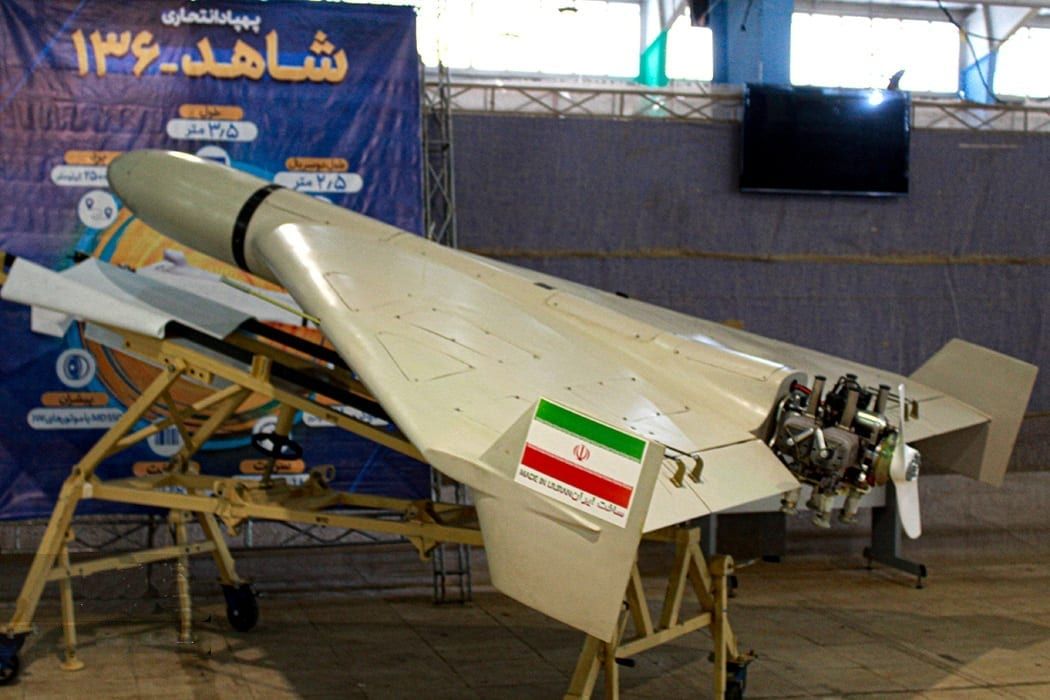
The HESA Shahed-136 is Iran's suicide drone used in Ukraine and the Middle East: 3.5 m long, 2.5 m wingspan, 2,500 km range, 90 kg warhead, ~$20,000 per unit.
Full Specifications
| Weight | ~200 kg (MTOW estimated) |
| Max Speed | 185–195 km/h |
| Wingspan | 2.5 m |
| Dimensions | Length: 3.5 m |
| Payload | 30–90 kg warhead (fragmentation) |
| Max Range | 1,000–2,500 km (estimated) |
| GPS | GPS + inertial navigation (INS) |
The Shahed-136 has become the defining symbol of modern loitering munitions: inexpensive, industrially scalable, and capable of causing damage disproportionate to its size. Developed by Iran's Aircraft Manufacturing Industrial Company (HESA), the suicide drone was first documented in combat in October 2022 in the Russia-Ukraine war, transferred to Russia, and has since been used directly by Iran in Middle East operations. In March 2026, Shahed-136 units struck three Amazon Web Services data centers in the UAE and Bahrain, marking the first time military drones caused physical damage to a major cloud provider's infrastructure.
What Is a Loitering Munition
A loitering munition is an unmanned aircraft designed to loiter over a target area for a defined period and then dive onto a physical target, detonating its warhead on impact. Unlike a cruise missile, which follows a pre-defined trajectory from launch, a loitering munition can wait for the optimal attack window, be redirected in flight, or aborted before impact.
This distinguishes the Shahed-136 from reusable combat drones like the Bayraktar TB2 or MQ-9 Reaper, which carry detachable munitions and return to base after a mission. The Shahed-136 itself is the weapon: it is consumed in every strike, which is central to its cost logic.
The Shahed-136 uses an MD-550 piston engine (Iranian manufacture), a delta wing configuration, and combined GPS+INS navigation. The redundancy between GPS and INS provides some resilience against localized jamming. It flies at 185–195 km/h at low altitude, reducing radar detection by low-power systems and minimizing acoustic signature. Unlike a jet, it passes unnoticed at medium distances.
Cost as a Strategic Weapon
The Shahed-136's strategic importance lies in its economics: estimated at $20,000–50,000 per unit, it costs less than most defensive interceptors fired to destroy it. A Patriot missile costs approximately $3–6 million. Shooting down a $20,000 Shahed-136 with a $3 million interceptor is, by design, economically unsustainable for the defender at scale.
Russia has used the Shahed-136 (designated Geran-2 in Russian service) in mass saturation attacks against Ukrainian energy infrastructure, sending waves of dozens of drones to overwhelm air defenses and exhaust interceptor inventories.
Countermeasures and Limitations
The drone's low speed (185–195 km/h) makes it trackable and interceptable by a wide range of systems when detected. Traditional air defense, electronic warfare (jamming), directed energy weapons, and even modified Soviet-era anti-aircraft guns have all been used against it effectively. The challenge is saturation: defending against many simultaneous attackers at low cost-per-round.
GPS jamming is partially effective; INS provides backup navigation that maintains course without GPS. Geofencing solutions and RF detection have emerged as complementary countermeasures for critical infrastructure protection.
Sources: IISS Military Balance 2023 | Royal United Services Institute (RUSI), Lessons from Ukraine