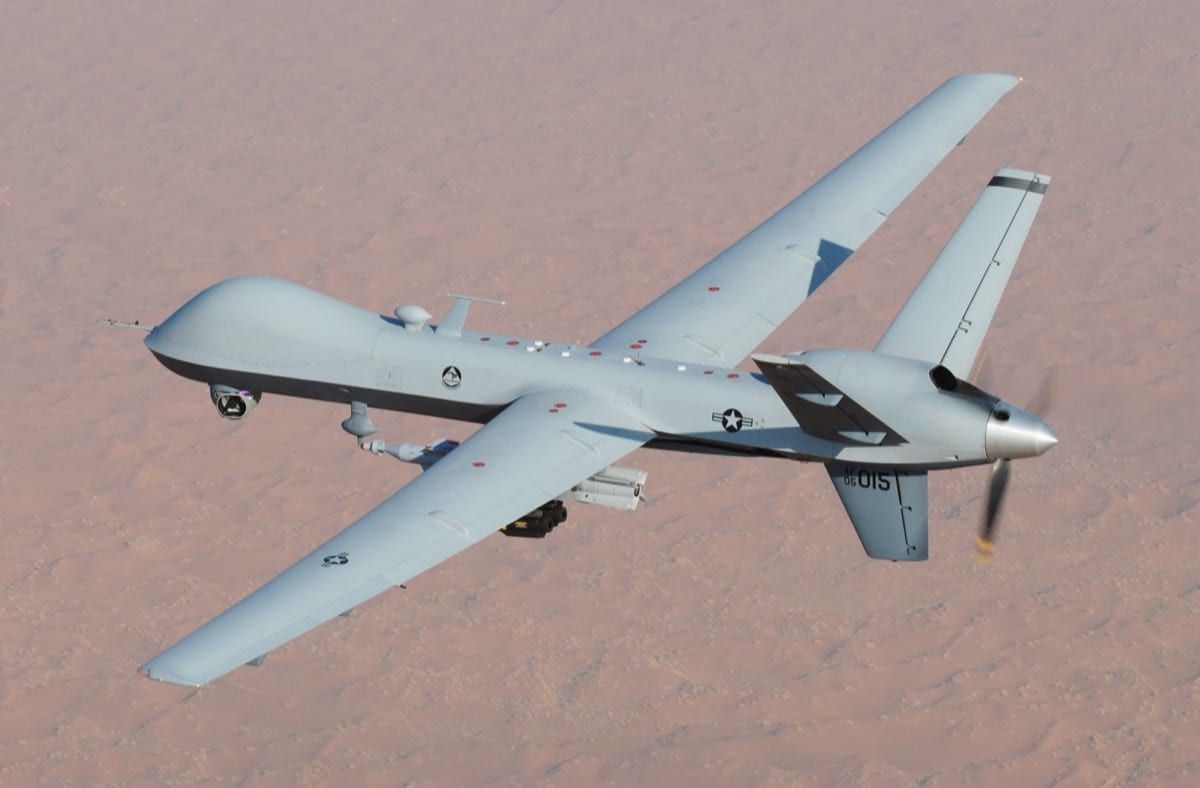
General Atomics MQ-9 Reaper
The MQ-9 Reaper costs $32 million per unit and dominated conflicts in Afghanistan, Syria and Yemen. Full specs, armament capability, and TB2 comparison.
Full Specifications
| Weight | 4,763 kg (MTOW) |
| Flight Time | 27 h |
| Max Speed | 482 km/h |
| Camera | AN/DAS-1 MTS-B (multi-spectral targeting): EO, IR, FLIR, laser designator, SAR radar |
| Payload | 1,746 kg (external) |
| Wingspan | 20.1 m |
| GPS | GPS + INS + autonomous navigation system |
| Dimensions | Length: 11 m |
The MQ-9 Reaper from General Atomics is the gold standard of military combat drones. In service with the United States Air Force since 2007, the Reaper has accumulated more combat flight hours than any other armed UCAV in history - and has participated in operations in Afghanistan, Iraq, Syria, Yemen, Somalia, and other theaters of conflict over nearly two decades.
Unlike the Bayraktar TB2 (small, relatively affordable, widely exported), the MQ-9 is a high-performance combat platform operated exclusively by the US military and close allies. The cost of a single Reaper is $32 million - more than many previous-generation fighter aircraft.
Operational Capability
With a 20.1-meter wingspan (similar to a small regional jet) and a Honeywell TPE331-10 turboprop engine, the Reaper flies at altitudes up to 15,000 meters - above the range of most portable anti-aircraft weapons - and remains on station for 14–27 hours depending on weapons load.
The aircraft is operated remotely by a crew of two: a pilot and a sensor operator, typically from Creech Air Force Base in Nevada or other remote locations thousands of miles from the theater.
Multi-Spectral Targeting System
The AN/DAS-1 MTS-B sensor pod integrates: stabilized electro-optical camera, infrared imager, FLIR sensor, laser rangefinder, and laser designator. This system enables the Reaper to identify, track, and designate targets for precision-guided munitions at operational altitudes.
Additionally, the Lynx SAR (Synthetic Aperture Radar) pod provides ground surveillance through clouds and in complete darkness.
Armament
Standard weapons loadout includes:
- AGM-114 Hellfire: primary anti-armor precision-guided missile (100 kg, 8 km range)
- GBU-12 Paveway II: 500 lb laser-guided bomb
- GBU-38 JDAM: GPS-guided bomb
- AIM-9X Sidewinder: air-to-air (limited deployment)
The seven underwing hard points support a maximum weapons load of 1,746 kg.
Cost and Strategic Role
At $32 million per aircraft plus $64,000 per flight hour, the Reaper is expensive - but comparatively economical relative to manned strike aircraft for persistent surveillance-to-strike missions. Its strategic role has been persistent intelligence, surveillance, and reconnaissance (ISR) combined with precision strike against high-value targets, particularly in counterterrorism operations.
Comparison with TB2 and Shahed-136
The Bayraktar TB2 operates in conflicts the Reaper was designed for, but at a fraction of the cost and with lower performance. The Shahed-136 represents a completely different concept - a loitering munition designed for mass production and saturation attacks rather than persistent ISR.
The Reaper represents the high-performance, high-cost extreme of the UCAV spectrum; the Shahed represents the low-cost, expendable extreme. The TB2 occupies the middle ground that has proven most strategically disruptive.
| System | Unit cost | Cost per flight hour |
|---|---|---|
| MQ-9 Reaper | $32 million | ~$64,000 |
| Bayraktar TB2 | $5–6 million | ~$1,000 |
| Shahed-136 | $20,000–50,000 | N/A (single-use) |
The gap illustrates three distinct strategic niches: the Reaper's persistent ISR-to-strike capability at high cost, the TB2's mid-cost precision-strike role, and the Shahed-136's expendable, mass-saturation economics.
Sources: USAF Fact Sheet - MQ-9 Reaper | General Atomics Aeronautical Systems