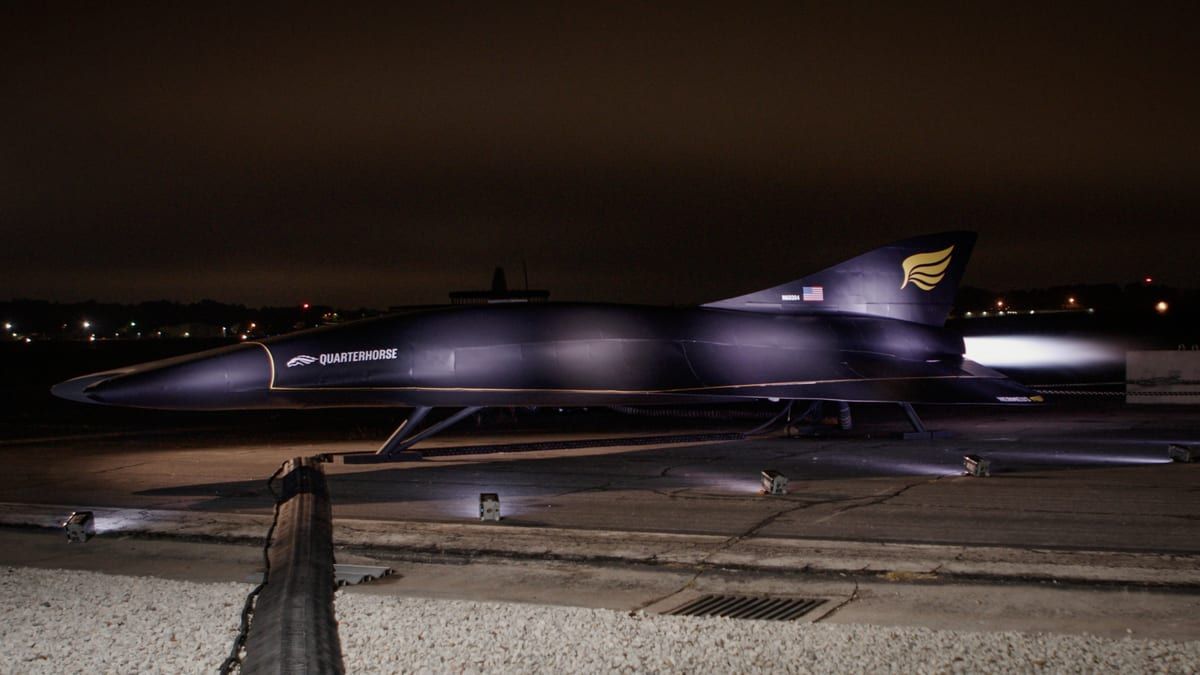
Hermeus Quarterhorse Mk 2.1
Quarterhorse Mk 2.1 flew in March 2026 with P&W F100 engine. Mach 3.3 on the horizon: how the fastest unmanned aircraft in development works.
Full Specifications
| Max Speed | Mach 2.5+ (Mk 2.1 target); Mach 3.3 (Mk 3 planned) |
| Dimensions | F-16 scale (~15 m length estimated) |
| Wingspan | Delta wing, not disclosed |
| GPS | Autonomous navigation system, specs classified |
| Payload | Not disclosed (demonstration aircraft) |
Hermeus conducted the first flight of the Quarterhorse Mk 2.1 on March 2, 2026, at Spaceport America in New Mexico, the most advanced hypersonic unmanned aircraft prototype ever built by a private company. With a modified Pratt & Whitney F100 engine and a proprietary precooler, the Mk 2.1 is the most concrete step toward Hermeus's stated goal: breaking the SR-71 Blackbird's speed record, which has stood unbroken since 1976.
Engine and Propulsion Technology
The Quarterhorse Mk 2.1 is powered by a Pratt & Whitney F100 engine, the same powerplant used in the F-16 and F-15. The differentiating element is a proprietary precooler installed at the air intake: a cooling system that reduces air temperature before compression, allowing the engine to operate efficiently at speeds where aerodynamic heating would normally destroy conventional components.
For subsequent versions (Mk 2.2 and Mk 3), Hermeus plans to replace the F100 with the Chimera II, an internally developed turbofan-scramjet combined-cycle engine. This engine would operate in two regimes: subsonic (as a conventional turbofan) and hypersonic (as a scramjet, without moving parts), making the Quarterhorse self-sustaining across its entire flight envelope without separate boosters.
Aerodynamic Configuration
The Quarterhorse uses a delta wing configuration optimized for hypersonic flight. At speeds above Mach 2, aerodynamic heating becomes the primary engineering constraint: the airframe must withstand skin temperatures exceeding 300°C continuously. The materials and thermal management system are classified, but Hermeus has disclosed the use of high-temperature alloys and active cooling in critical sections.
The fuselage length is approximately F-16 scale (~15 meters), making it significantly smaller than the SR-71 (32.7 meters). The smaller airframe is intentional for a demonstration vehicle, not a production aircraft.
Program Timeline and Context
Hermeus was founded in 2018 with a declared goal of developing hypersonic aircraft for both government and commercial applications. The Quarterhorse program is the demonstration path:
- Mk 1 (2022): aerodynamic demonstration at low speed
- Mk 2.1 (March 2026): first powered hypersonic flight attempt with F100
- Mk 2.2: target Mach 2.5+ with F100 + precooler fully validated
- Mk 3: target Mach 3.3 with Chimera II engine
The SR-71 record is Mach 3.3 (2,193 mph). Matching or exceeding it with an autonomous unmanned aircraft would represent a significant milestone in private aerospace.
Strategic Significance
DARPA and the US Air Force Research Laboratory (AFRL) have funded Hermeus as part of a broader push to restore US hypersonic capability following decades of underinvestment. While Russian and Chinese hypersonic missile programs have advanced rapidly, the US has focused on hypersonic glide vehicles (like LRHW) and air-breathing platforms. Hermeus represents the latter approach.
Sources: Hermeus, Quarterhorse program updates | Spaceport America press release, March 2026