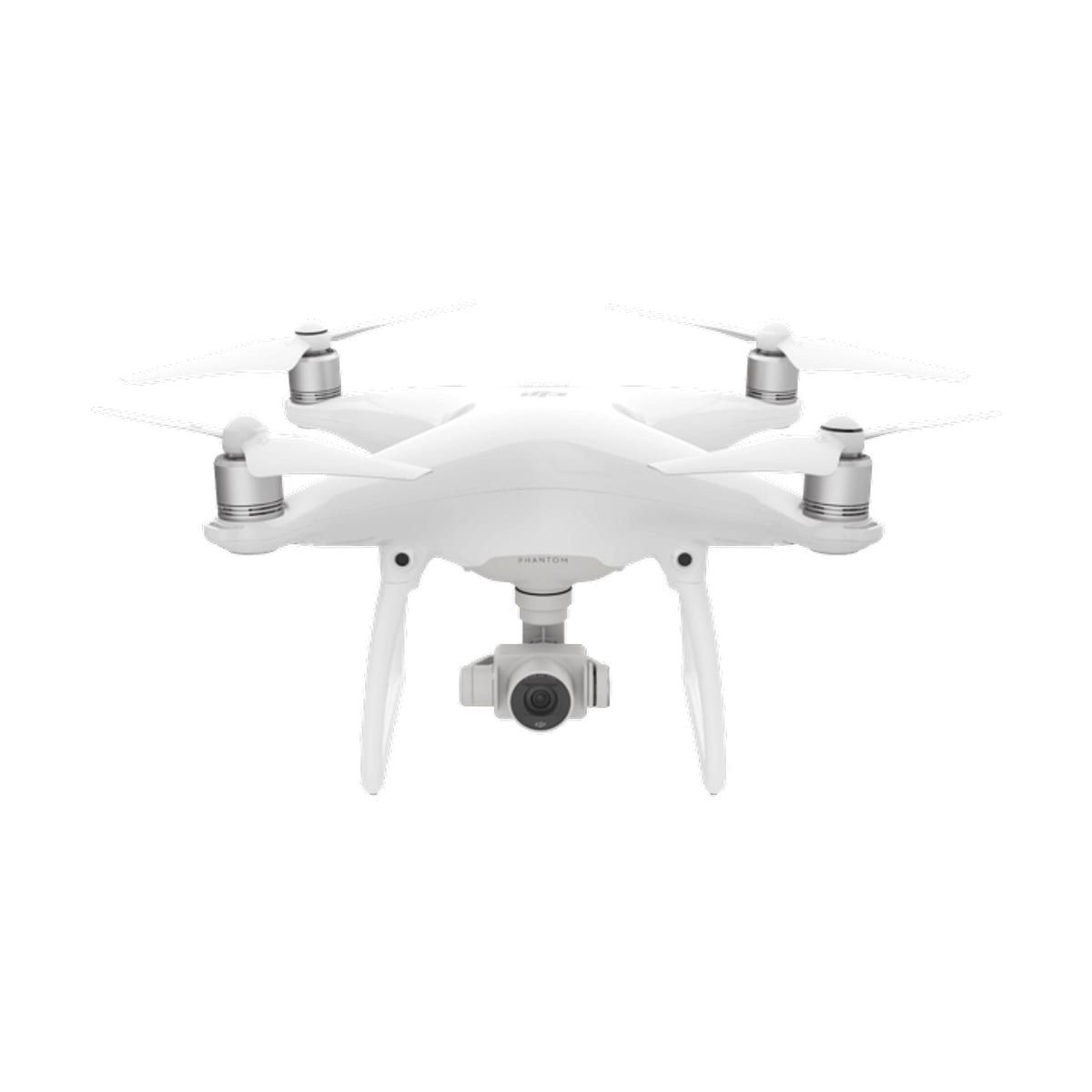
DJI Phantom 4
The DJI Phantom 4 (2016) made pro aerial photography accessible to everyone. Discontinued but historic, found on the secondary market. Specs and context.
Price (USD)
$300
Full Specifications
| Weight | 1.38 kg |
| Flight Time | 28 min |
| Max Speed | 72 km/h |
| Camera | CMOS 1/2.3", 12 MP, f/2.8, FOV 94° |
| Video | 4K/30fps, FHD/120fps |
| Obstacle Avoidance | Forward (stereo vision) |
| Max Range | 5 km (CE) |
| Wind Resistance | Level 5 (22 mph) |
| GPS | GPS + GLONASS |
| Dimensions | 289 × 289 × 196 mm |
March 2016. DJI launches the Phantom 4 with a feature no consumer drone had ever offered before: automatic obstacle avoidance. Two stereo vision sensors on the front of the drone detected trees, people, and walls and autonomously steered around them, without pilot intervention.
Nearly a decade later, this capability is present in drones costing $300. In 2016, the Phantom 4 was the only drone in the world with this ability, selling for $1,399 at a time when competition was minimal. It weighed 1.38 kg and shipped with a 1/2.3" CMOS camera shooting 12 MP stills and 4K/30fps video.
Looking for the professional surveying variant? This page covers the original 2016 consumer Phantom 4. If you need centimeter-accurate RTK positioning for mapping and photogrammetry, see the DJI Phantom 4 RTK instead.
Why the Phantom 4 Was Revolutionary
Before the Phantom 4, drone flying was inherently high-risk. A moment of inattention, a failed stick input, a branch the pilot didn't see: any of these crashed a drone with no recourse. The Phantom 4 changed the risk calculus fundamentally.
Beyond obstacle avoidance, it introduced TapFly (point-and-fly navigation) and ActiveTrack (subject following), the foundations of the automated flight modes that are now standard across the industry.
The camera captured 4K at 30fps with electronic image stabilization, 12 MP stills, and 1080p/120fps for slow motion. By the standards of 2016, this was exceptional. By today's standards, it's basic, but for understanding the era, it was genuinely transformative.
Historical Significance
The Phantom 4 marked the moment recreational drone flying became accessible to people without engineering backgrounds. It was the catalyst for the aerial photography business that employs tens of thousands of professionals today, and established DJI's market dominance that has defined the industry ever since.
Secondary Market
On the used market, the Phantom 4 sells for $200–400 depending on condition. It has no current practical use for anyone needing a working tool: the Mini 2 SE at $299 has a better camera, is lighter, and has active firmware support. The Phantom 4 today is a collector's piece or nostalgia purchase.
Historical context: DJI Phantom 4 product page